

 Hannah Brooks
The Calm Cook’s Guide to Ounces and Cups
A long read, about 25 minutes
The Quiet Reason Ounces to Cups Trips Everyone Up
You are halfway through a recipe and you reach the line that says twenty four ounces of broth. Your hands are floury, the timer is running, and the only measuring tool within reach is a one cup glass. Suddenly the question is not how to cook. The question is how to do basic kitchen math while a pan starts to smoke behind you. This is the small, almost embarrassing moment that makes home cooks look up ounces to cups conversions a few times a week. The reason it keeps catching us out is not that the math is hard. The math is genuinely simple. The trouble is that ounces and cups are the kind of measurements that look obvious until you actually need them, and then they suddenly remember they have feelings about which country you are in.
Most kitchens in the United States lean on a quiet rule of thumb. Eight fluid ounces makes one cup. Two cups make a pint. Four cups make a quart. Sixteen cups, give or take, make a gallon. That little stack of relationships covers ninety percent of everyday cooking, which is why this article is going to spend a lot of time making sure you really, deeply own that stack. Once it lives in your bones, the calculator above becomes a backup, not a crutch. You will glance at a recipe, hear the conversion in your head, and keep stirring.
The other ten percent is where the trouble starts. A British scone recipe written in cups will quietly use a different cup. A bag of flour does not weigh the same per cup as a bag of sugar. A baby bottle is not measured the same way as a cocktail. A pharmaceutical measurement is not the same as a barista measurement. The rest of this guide walks through every one of those edge cases in plain English, with shortcuts you can keep in your head, so the next time the kitchen gets loud and the recipe gets weird, you stay calm.
The Rule of Eight in Plain English
If you remember nothing else from this guide, remember this. In the United States, one cup of liquid equals eight fluid ounces. That single fact is the doorway through which every other conversion walks. From it you get the entire ladder of kitchen math, in both directions, with very little effort.
Going from ounces to cups, you divide by eight. Sixteen ounces becomes two cups. Twenty four ounces becomes three cups. Twelve ounces becomes one and a half cups. Six ounces becomes three quarters of a cup. Going the other way, you multiply cups by eight. A cup and a quarter becomes ten ounces. Half a cup becomes four ounces. The math is so consistent that experienced cooks stop noticing they are doing it.
What makes this rule a little slippery is the word ounce. In American kitchens, ounce often means fluid ounce, which is a measure of volume. But ounce can also mean weight ounce, which is a measure of mass. They are not the same number unless the substance happens to weigh exactly one gram per millilitre, which is roughly true for water and almost nothing else. The rule of eight only works cleanly when you are dealing with fluid ounces of a watery liquid. We will untangle that distinction in detail a little further down. For now, hold on to the one sentence that matters most. Eight fluid ounces equals one US cup.
A small companion sentence helps too. Two tablespoons equal one fluid ounce. So if a recipe asks for two ounces of olive oil and you only have measuring spoons, you reach for four tablespoons. If it asks for one ounce of vanilla, that is two tablespoons. The tablespoon is the secret bridge between ounces and the rest of your drawer of small implements. Once you know it, you can almost always improvise your way to a clean number.
A Short, Honest History of the Cup
The cup is one of the strangest units of measurement still in widespread daily use. Almost every other unit you cook with has been formally pinned down by a government somewhere. Litres, grams, kilograms, all of them have legal definitions that sit in vaults in Paris. The cup, by contrast, has spent most of its life as a friendly suggestion. The teacup that became the standard in nineteenth century American cookbooks was, quite literally, the size of an average teacup. Different cookbooks used different cups for decades, which is why old American recipes can feel oddly inconsistent when you try to revive them today.
In the early twentieth century, the United States Food and Drug Administration finally decided to stop the chaos and define a legal cup as exactly two hundred forty millilitres. That is the cup printed on every nutrition label you have ever read. It is not, however, the cup that lives inside most American kitchens. The cup most home cooks actually use, the one in your nested set in the drawer, is the older customary cup, which is two hundred thirty six and a half millilitres. The difference is about three and a half millilitres per cup, which is small enough not to matter for most cooking and large enough to drive bakers crazy if they happen to be working in grams.
Then there is the metric cup, which Australia and New Zealand decided was a perfectly round two hundred fifty millilitres, because they were going to switch to metric anyway and they liked clean numbers. There is the United Kingdom cup, which was historically half a British imperial pint, working out to a generous two hundred eighty four millilitres. And there is the Japanese cup, traditionally used for cooking rice, which is exactly two hundred millilitres. Five different cups, all called a cup, all sitting on supermarket shelves in different parts of the world.
The reason this matters in your kitchen is simple. The size of the cup the original recipe was written for changes how much of an ingredient you actually pour in. Use an Australian metric cup with an American recipe and you will quietly add about four percent more of every ingredient. That is enough to throw off a delicate cake. Use a UK cup with the same American recipe and you will add almost twenty percent more, which is enough to ruin almost anything. The calculator on this page lets you set both ends of that equation, but it pays to know which cup you actually own.
Why a British Recipe Will Quietly Sabotage You
Imagine a friend in London sends you her grandmother’s scone recipe. You bake it on a quiet Saturday morning in Boston. The dough is wrong. It is wetter than it should be, sticky in places it should be crumbly, and the scones come out of the oven flat and a bit sad. You did nothing wrong, technically. You followed every line of the recipe. The trouble is that her cup and your cup are not the same cup. Hers is just under one and a quarter of yours. Every single measurement on her recipe was secretly larger than what your nested set was pouring out.
The fix is not complicated, but it does require attention. When a recipe is written by someone in the United Kingdom, Ireland, parts of Canada, or Australia and New Zealand, ask yourself what cup they meant. If the recipe is from a serious cookbook, the front matter usually tells you. If it is a blog post or a passed down family recipe, you will need to look at the country of origin and make a sensible guess. The calculator above will then translate every cup into your cup with no fuss.
The fluid ounce has the same quiet trap. A US fluid ounce is about twenty nine and a half millilitres. A British, or imperial, fluid ounce is about twenty eight and a half. The British ounce is a touch smaller, but it is also bundled differently. A British pint is twenty fluid ounces, not sixteen. A British quart is forty fluid ounces. A British gallon is about one hundred sixty fluid ounces, which is why a British gallon of petrol is bigger than an American gallon of gasoline. None of this matters in everyday cooking unless your recipe has crossed an ocean. When it has, the calculator is your friend, and so is reading the source country before you start cracking eggs.
Weight Versus Volume, the Mistake Most Bakers Make
Here is a sentence that quietly trips up almost every home baker. One cup of flour does not weigh eight ounces. Cups measure volume, which is how much space something takes up. Ounces, in the weight sense, measure mass, which is how heavy something is. Water happens to weigh almost exactly eight ounces per cup, which is the historical reason the cup got mixed up with the ounce in the first place. But flour weighs about four and a quarter ounces per cup. Sugar weighs about seven. Honey weighs about twelve. Butter weighs about eight, but only because butter happens to be roughly as dense as water.
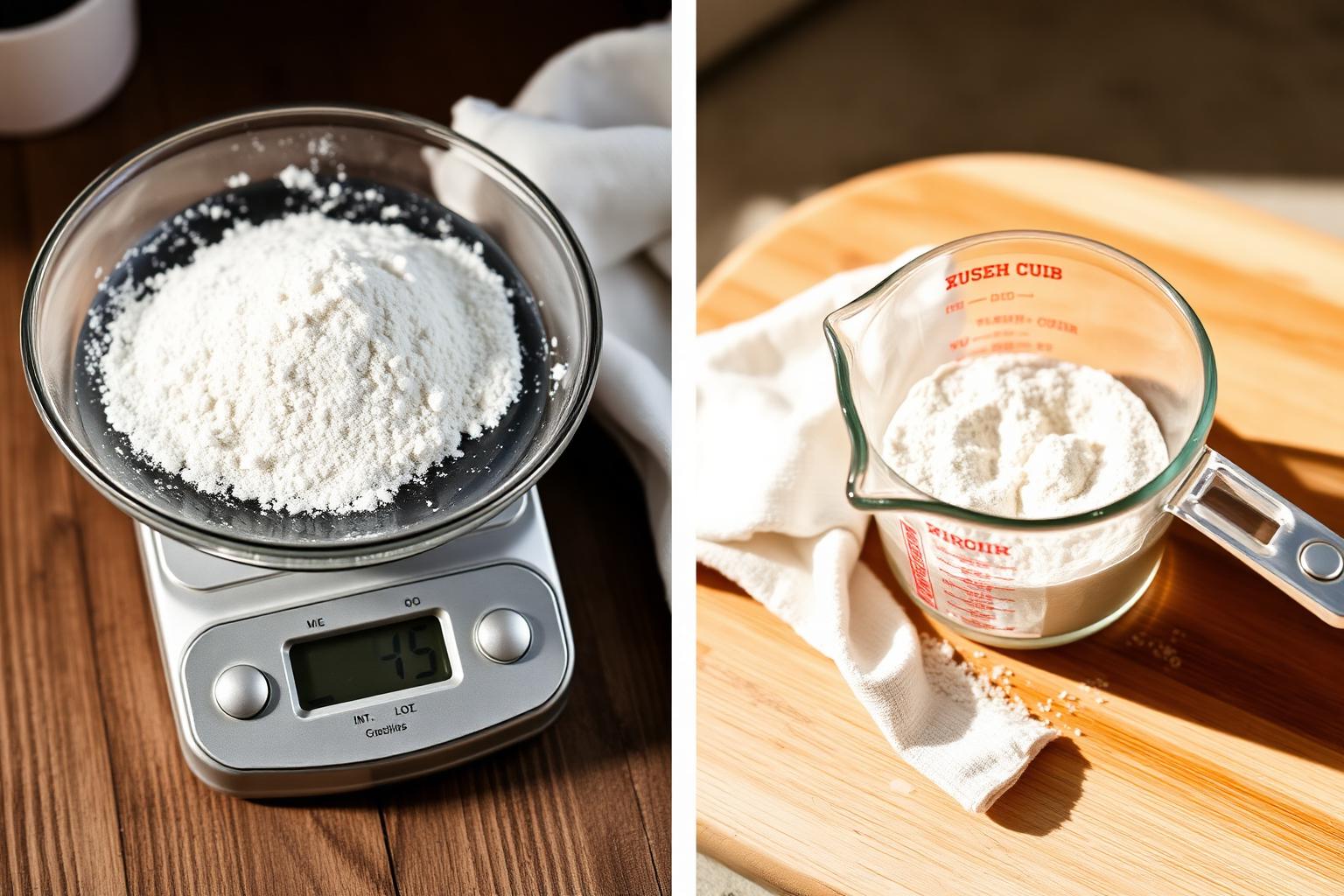
This is why a kitchen scale is the single best upgrade an ambitious home cook can make. Weighing flour gets you a consistent loaf of bread every time. Measuring flour by the cup gets you a different loaf depending on how packed the flour was, how much air was in the bag, and whether you spooned it in or scooped it. The traditional American spoon and sweep method gives you about four and a quarter ounces of all purpose flour per cup. The dip and pack method, where you push your cup into the bag and level it off, can give you over five ounces. That is a fifteen percent error before you have done anything else.
For everyday cooking, the difference does not really matter. Pasta sauce will be fine. Soup will be fine. Most cookies will be fine. For baking that is supposed to be precise, like macarons or bread or laminated pastry, weighing is dramatically more reliable than measuring. If you ever wonder why your favorite YouTube baker keeps reaching for a scale instead of a cup, this is the answer. They are not being fussy. They are removing a quiet, expensive source of error.
Common Ingredients and What an Ounce Really Means
Because density varies so much from one ingredient to another, it helps to keep a few cup to ounce relationships in your head. These are the ones that come up most often in everyday cooking.
- Water and milk, about eight ounces per cup by weight. The friendly base case.
- All purpose flour, about four and a quarter ounces per cup, spooned and leveled.
- Bread flour, about four and a half ounces per cup. Slightly heavier because it is more glutenous.
- Granulated sugar, about seven ounces per cup.
- Brown sugar, packed, about seven and a half ounces per cup.
- Powdered sugar, about four ounces per cup. Surprisingly light because it is full of air.
- Butter, about eight ounces per cup, two American sticks.
- Honey or maple syrup, about twelve ounces per cup. Sticky and dense.
- Olive oil, about seven and a half ounces per cup.
- Rolled oats, about three ounces per cup. Mostly air.
- Cocoa powder, about three and a half ounces per cup.
None of these numbers need to be memorized perfectly. They are just useful anchors so the next time a recipe asks for six ounces of flour, you know that is a touch under one and a half cups, not three quarters of a cup. The faster you can mentally bridge between weight and volume, the calmer your kitchen feels.
The Tools That Make This Easy
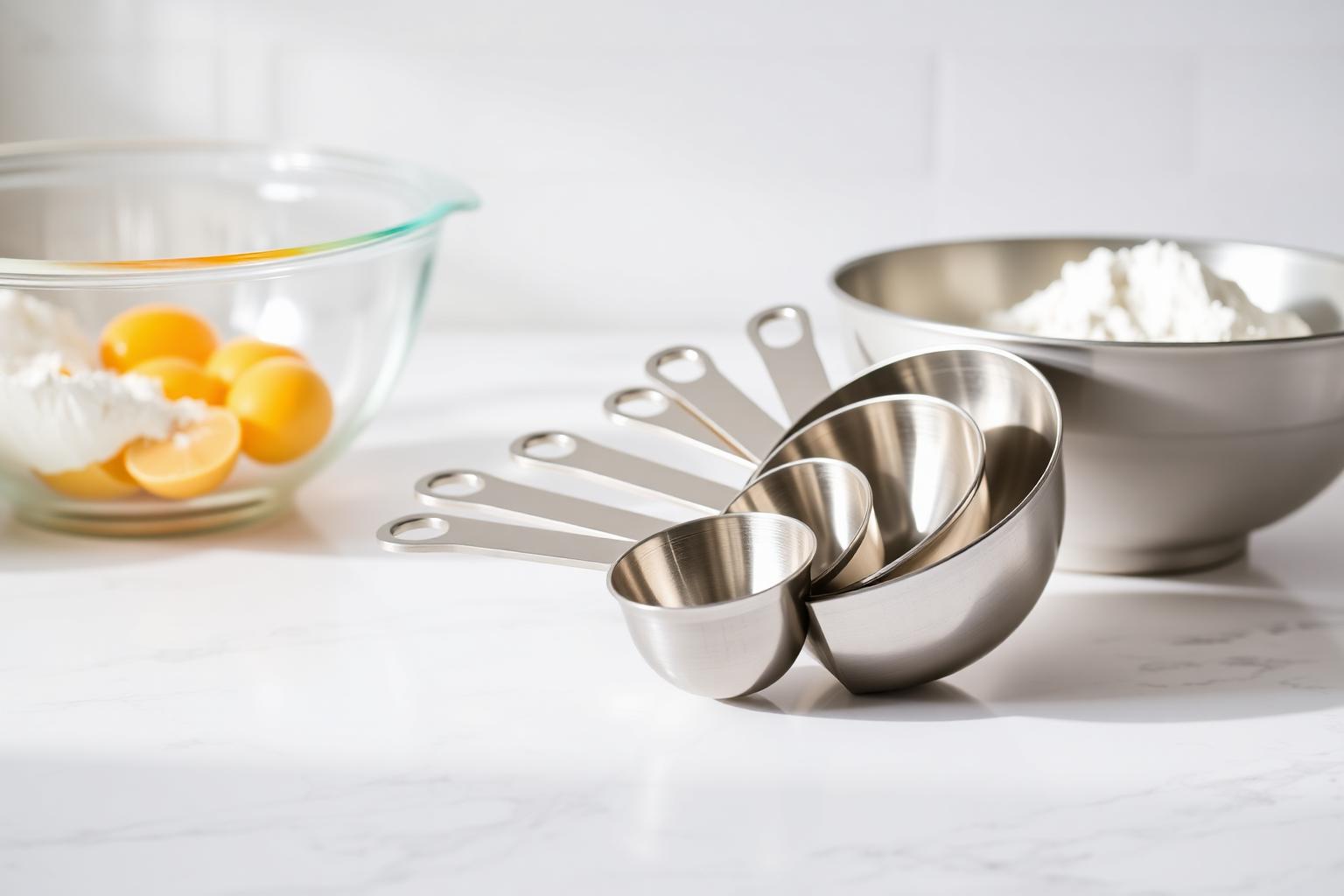
You only really need three things to handle every conversion this guide talks about. A nested set of dry measuring cups, a clear glass liquid measuring cup with markings on the side, and a small digital kitchen scale that can switch between grams and ounces. That is the entire kit. You can spend your money on fancier knives and pans with confidence, knowing the measuring side of your kitchen is fully sorted.
Dry cups and liquid cups are not interchangeable, which surprises many people. Dry cups are flat across the top so you can level a heap of flour with the back of a knife. Liquid cups have a spout and clear markings on the side so you can pour a liquid up to a line without losing any. Trying to measure flour in a liquid cup is awkward. Trying to measure milk in a dry cup is messy. Use each tool for the job it was designed for and your life gets easier.
How to Actually Read a Liquid Measuring Cup
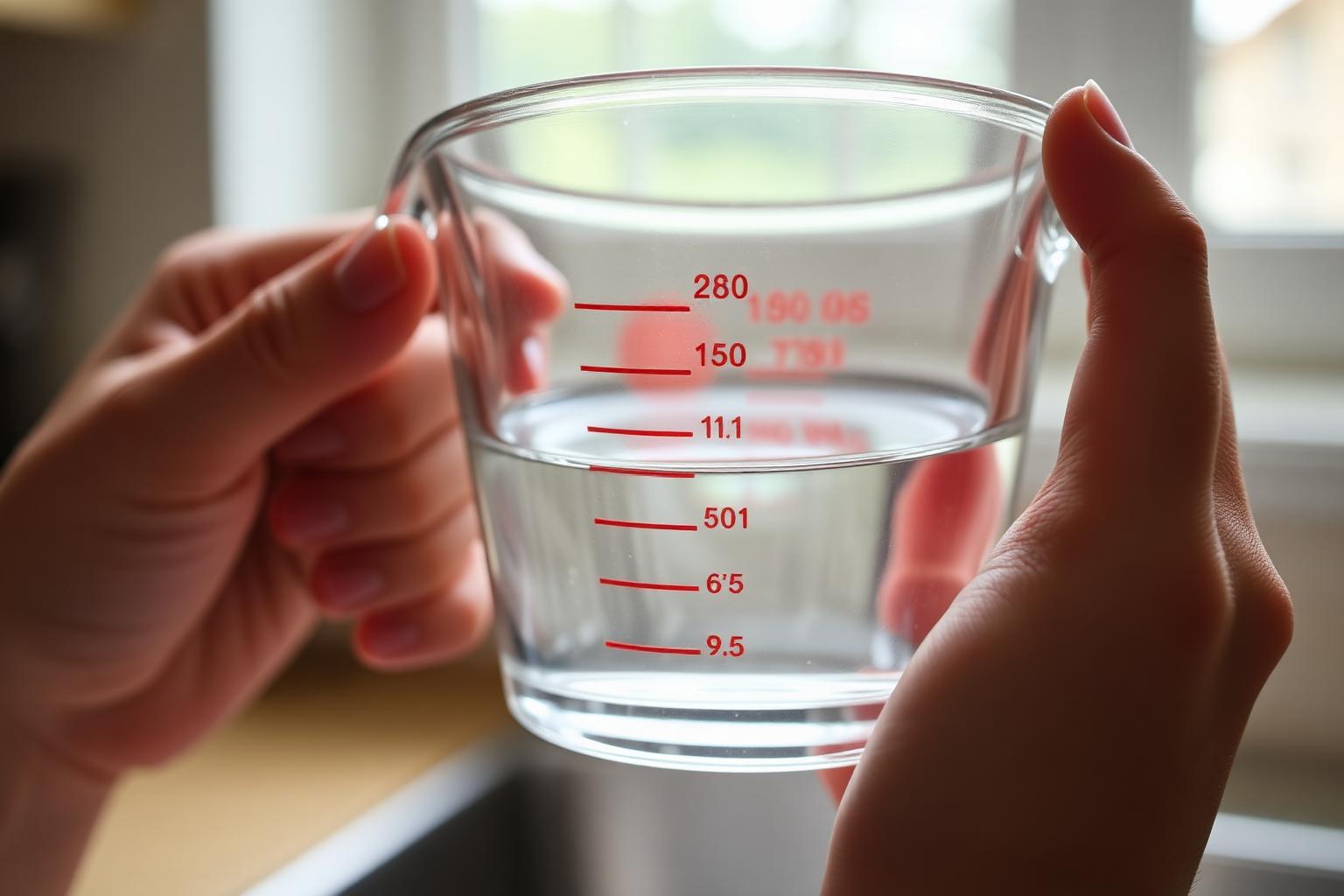
This sounds laughably simple until you watch a few people do it wrong. A liquid measuring cup must be read at eye level. Lift it off the counter, hold it level, and look at the surface of the liquid from the side. You will see that water curves a little inside the glass. The bottom of the curve, the part that dips down toward the cup, is called the meniscus. The bottom of the meniscus is the line that counts. If you read the cup from above, looking down, you will pour about ten percent more than you mean to, every single time, for the rest of your cooking life.
For viscous liquids like honey, a light coating of warm water or oil on the inside of the cup helps the honey slide cleanly out without leaving a sticky tablespoon behind on the wall of the cup. For sticky things like peanut butter, a quick spritz of cooking spray inside the cup does the same job. These are the small habits of cooks who never have to scrape twice.
Scaling Recipes Without Losing Your Mind
One of the most useful kitchen skills is being able to take a recipe written for four people and quietly turn it into a recipe for six, or twelve, or two. This is where the cleanness of the rule of eight pays off the most. If a sauce calls for twelve ounces of cream and you are doubling the recipe, you need twenty four ounces, which is exactly three cups. No calculator required. If you are halving it, you need six ounces, which is three quarters of a cup. Again, you can do this in your head while you stir.
The trickier part of scaling is that not everything scales linearly. Spices, for example, get more aggressive when you double them. The right move when you double a curry is to multiply most of the spices by about one and a half, taste, then add more if needed. Salt and acidity, the two ingredients that make food actually taste like food, should always be added in stages and tasted between stages, not poured in to a doubled measurement and then regretted. Liquids and fats scale almost perfectly. Leavening agents like baking soda and baking powder scale almost perfectly too, up to a point, after which the chemistry changes. For a doubled batch of pancakes, double everything. For a quadrupled batch, drop the leavening by about ten percent or you will get a strange aftertaste.
For ounce to cup conversions specifically, the math during scaling stays the same, only the inputs change. Once you trust the rule of eight, you stop doing arithmetic and start cooking.
Going Metric Without Throwing Out Your Cookbook
More and more recipes online are written in metric, especially baking recipes from European chefs and food writers. The good news is that you do not have to choose a side. You can keep your American cups, add a digital scale that switches between grams and ounces, and read recipes in either system without translating much in your head.
A few anchor numbers help when you do need to switch on the fly. One US cup of water is about two hundred forty millilitres. One US cup of water also weighs about two hundred forty grams, because water happens to be a very tidy substance. One fluid ounce is about thirty millilitres. One ounce in weight is about twenty eight grams. A pound is about four hundred fifty grams, just under half a kilogram. Once those four anchors are in your head, you can read a metric recipe and have a rough sense of what you are dealing with before you reach for any tool.
European baking recipes that list flour in grams are usually more accurate than American recipes that list flour in cups, for the reason we discussed earlier. If you are serious about baking and you find yourself reaching for European recipes often, switching to grams permanently is one of the most quietly satisfying upgrades you can make. Your bread will improve. Your cakes will become more consistent. The only real cost is reading new numbers for a few weeks until they start to feel native.
The One Page Kitchen Cheat Sheet
If you want a single, printable list of relationships to tape to the inside of a cabinet door, this is it. Everything below assumes US fluid ounces and US legal cups, which covers almost every American recipe.
- Two tablespoons equals one fluid ounce.
- Eight fluid ounces equals one cup.
- Sixteen fluid ounces equals two cups, which is one pint.
- Thirty two fluid ounces equals four cups, which is one quart.
- One hundred twenty eight fluid ounces equals sixteen cups, which is one gallon.
- Four ounces equals half a cup.
- Six ounces equals three quarters of a cup.
- Twelve ounces equals one and a half cups.
- Twenty four ounces equals three cups.
- Forty eight ounces equals six cups, which is a generous pitcher of lemonade.
That list, plus a clear understanding that flour does not weigh the same as water, will carry you through almost every recipe you will ever cook.
Bartending, Coffee and Smoothies: A Different World
The drinks world has its own measurement vocabulary, and a quick translation helps. A standard American jigger is one and a half fluid ounces. A pony is one fluid ounce. A double pour is two ounces, which is a quarter of a cup. A standard cocktail typically uses two ounces of base spirit, which is a quarter cup. So the next time you are mixing margaritas without a jigger, two tablespoons per ounce is your friend.
Coffee is delightfully precise once you learn the language. Specialty coffee is usually measured in grams of coffee to grams of water, with sixteen to one being a popular ratio. Twenty grams of coffee, three hundred twenty grams of water. Translated into kitchen units, three hundred twenty grams of water is just under one and a half cups, or about eleven fluid ounces. The reason the coffee world prefers grams is the same reason the baking world does. It removes a quiet source of error and makes your morning cup taste the same every day.
Smoothies are forgiving and do not really care. A typical blender holds about six cups, which is forty eight fluid ounces. If you are starting with a cup of milk and a cup of yogurt and a cup of frozen berries, you have used three cups and have plenty of headroom for fruit, ice and nut butters before you risk an overflow. Treat your blender like a measuring cup with a lid and a motor, and smoothie making becomes an act of casual abundance rather than fussy math.
Baby Bottles, Medicine and the Stakes of Getting It Right
Two areas of the home where ounces matter more than usual are baby feeding and medicine. American baby bottles are marked in fluid ounces, with the same eight ounces to a cup relationship. A typical newborn bottle holds two to three ounces. A toddler bottle holds six to eight. Following the formula manufacturer’s instructions exactly is more important than any general rule, because formula is calibrated for a precise water to powder ratio. The calculator on this page can help you scale a batch up or down, but the manufacturer’s own measuring scoop is the source of truth.
For medicine, especially for children, the safest tool is a marked oral syringe, almost always calibrated in millilitres. One fluid ounce equals about thirty millilitres, but for a children’s dose, you want the millilitre number directly off the bottle and into the syringe. A teaspoon of liquid medicine is about five millilitres. A tablespoon is about fifteen millilitres, or half a fluid ounce. Pharmacists everywhere quietly wish people would use the syringe, not the household teaspoon, because household teaspoons vary wildly in actual size.
Five Mistakes That Quietly Ruin Recipes
The following five errors are responsible for most of the kitchen frustration this article is trying to prevent. They are easy to fix once you can name them.
- Mistake one, mixing up fluid ounces and weight ounces. Eight ounces of flour is not one cup. Eight fluid ounces of milk is one cup. The shorthand on a recipe usually points one way or the other through context. If a recipe says ounces in a paragraph about wet ingredients, it usually means fluid. If it appears next to a weight on a label, it means mass.
- Mistake two, using a UK or Australian recipe with US cups. A casual mismatch like this can quietly add or remove twenty percent of every ingredient. Always check the country of origin on a recipe before you start, and either swap to grams or use the calculator above.
- Mistake three, dipping the cup into the flour bag. This packs the flour and gives you fifteen to twenty percent too much. Spoon the flour into the cup, then level off the top with the back of a knife.
- Mistake four, reading a liquid measuring cup from above. Always at eye level. The meniscus is your friend.
- Mistake five, scaling a recipe but forgetting that spices and salt do not behave linearly. Double the liquids and fats freely. Be cautious with the seasonings and add them in stages, tasting as you go.
Mental Shortcuts You Will Actually Remember
Memorize these and you will look up an ounces to cups conversion almost never. They are the kind of small kitchen wisdom that compounds over years.
- Half a cup is four fluid ounces. Anytime a recipe says four ounces of liquid, you can reach for a half cup measure.
- A cup is eight fluid ounces. Two cups is sixteen, which is also a pint, which is also a typical pint of beer in the US.
- A quart is thirty two fluid ounces, which is also a litre, give or take a small amount. If you need a litre and only own American measures, four cups is close enough for almost any recipe.
- A stick of butter weighs four ounces and equals half a cup. So one cup of butter is two sticks.
- One fluid ounce equals two tablespoons, equals six teaspoons. The ladder works in either direction.
- An espresso shot is about one fluid ounce. A double shot is two ounces. A standard cocktail pour is also two ounces. The bartending world quietly agrees with the espresso world.
- A typical wine pour is five fluid ounces, which is just over half a cup. A bottle of wine is about twenty five ounces, or just over three cups.
The Calm, Confident Cook You Are Becoming
Conversions are one of those skills that quietly separate a tense home cook from a confident one. The tense version reaches for a calculator at every line of a recipe, second guesses every number, and ends up with something that turned out, somehow, fine. The confident version reads the recipe once, hears the cups and ounces snap into place in their head, and starts cooking with both hands free. The difference between the two is not talent. It is a few hours of paying attention, a single rule of eight, and the willingness to keep a small cheat sheet in a cabinet for the days the kettle is boiling and the timer is going off.
You now own all of the tools. You know that one US cup is eight fluid ounces. You know that the cup you actually use in your kitchen is almost certainly close enough to the official cup that it will not matter for everyday cooking. You know that British cups and Australian cups and Japanese cups exist, and you know how to spot a recipe that wants you to switch. You know the difference between weight and volume, and why your scale is the secret weapon for serious baking. You know how to read a liquid cup at eye level, how to spoon flour without packing it, and how to scale a recipe without losing the seasoning.
The calculator above will catch you on the days you are tired, distracted, or working with a recipe from a country whose cup is unfamiliar. The cheat sheet on your cabinet door will catch you on the days you forget. The mental shortcuts will catch you on every other day. Between the three of them, you have a complete safety net for one of the most useful, undervalued skills in the home kitchen. Go cook something. The math is no longer in the way.