Free bitumen calculator for any road, driveway or paving job. Estimate asphalt tonnage, bitumen quantity, binder content, aggregates and material cost from your road length, width and pavement thickness — metric or imperial.
Created by
Daniel Whitman
Reviewed by
Hannah Brooks
Dimensions & mix properties
Enter your pavement layer to get total mix, bitumen and aggregate quantities.
%
$
Total mix volume
175.00 m³
Total mix weight
411.25 tonnes
411,250 kg
Weight of bitumen
22.62 tonnes
22,619 kg
Weight of aggregates
388.63 tonnes
388,631 kg
Was this calculator helpful?
Was this helpful?
Votes are stored on your device. Help others find this tool — share, embed, or cite it.
How the bitumen calculator works
The calculator follows the standard asphalt mix-design chain used by paving engineers. All inputs are converted to SI units before the maths runs, so you can mix metric and imperial measurements without breaking the result.
Standardise units. Length and width to metres, thickness to metres, density to kg/m³.
Mix volume (m³) = Length × Width × Thickness.
Total mix weight (kg) = Volume × Mix Density. Divide by 1,000 for tonnes.
Aggregate weight = Total Mix Weight − Bitumen Weight.
Estimated cost = Total Mix Weight (tonnes) × Price per Tonne (optional).
Bitumen quantity formula
The condensed formula combining every step:
Bitumen Qty = L × W × T × Density × (Bitumen % ÷ 100)
Worked example: a 1 km × 3.5 m × 50 mm asphalt layer at a density of 2,350 kg/m³ and 5.5% bitumen content yields 175 m³ of mix, 411.25 tonnes total weight, 22.62 tonnes of bitumen and 388.63 tonnes of aggregates.
Typical bitumen content by mix type
Mix type
Bitumen %
Typical use
Dense-Graded HMA
5.0 – 6.0%
General paving
Stone Mastic Asphalt (SMA)
6.0 – 7.0%
High-traffic roads
Open-Graded Friction Course
4.5 – 5.5%
Highway drainage layer
Porous Asphalt
5.5 – 6.5%
Permeable pavements
Polymer-Modified
5.5 – 7.0%
Heavy duty / airports
Understanding the Bitumen Calculator for Accurate Estimations
In-depth guide · ~10 min read
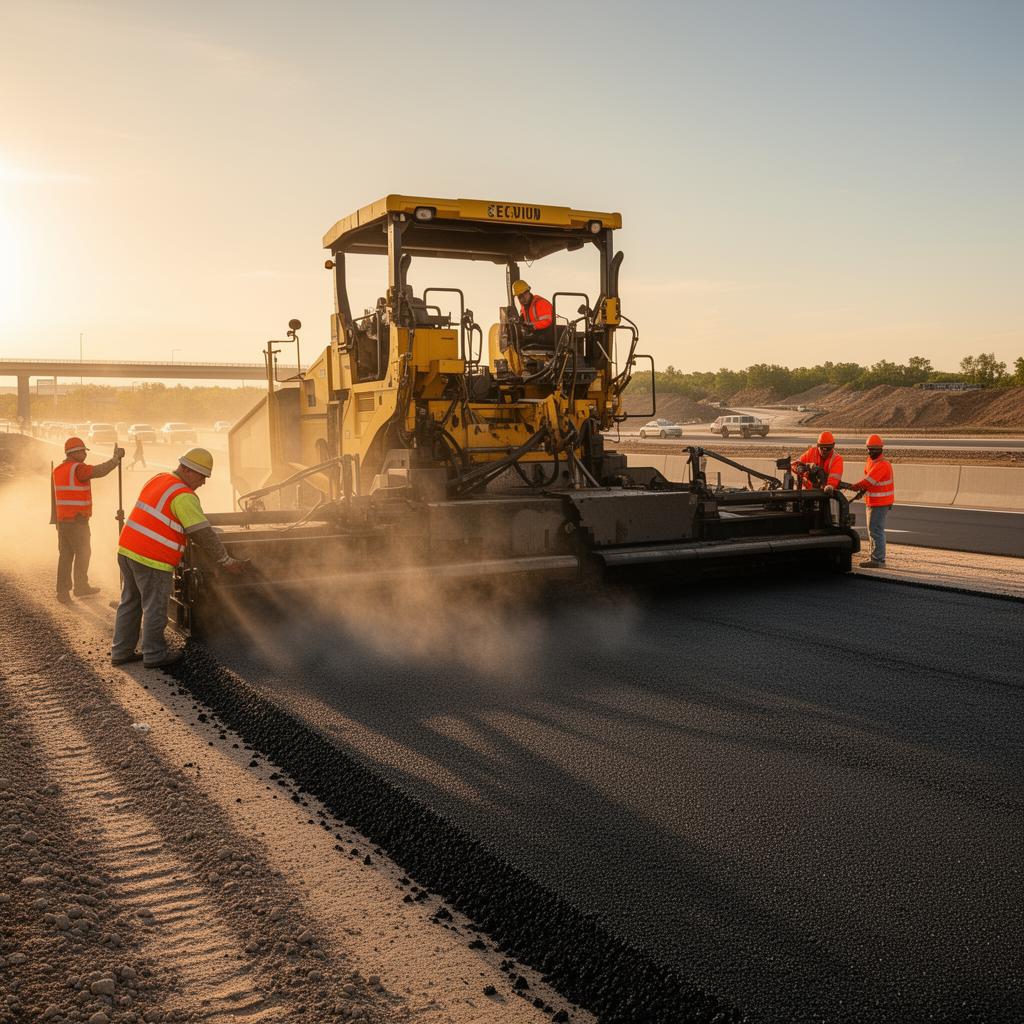
Hot-mix asphalt paving — accurate bitumen estimation keeps projects on budget.
If you're estimating a paving job, the question is almost never "how much bitumen do I need?" in isolation — it's "how many tonnes of hot mix do I need to order, what will it cost, and how much of that tonnage is the binder I'm paying a premium for?" That's what a good bitumen calculator answers, and it's why the same tool gets used as an asphalt calculator, an asphalt tonnage calculator, a blacktop calculator, and — for flat roofs — a modified bitumen roof calculator. They're all the same maths with different inputs.
This guide walks through the formula, three worked examples (driveway, 1 km road overlay, commercial flat roof), and the handful of mistakes that actually blow up estimates in the field. If you just want a number, scroll back up — the calculator at the top runs the maths instantly. If you want to trust that number, keep reading.
Bitumen vs asphalt — what you're actually measuring
Half the confusion in this industry comes from "asphalt" and "bitumen" being used interchangeably depending on which country you're standing in. In US English, "asphalt" usually means the full mix you pour (binder + aggregate) and the black liquid binder is called asphalt cementor bitumen. In UK and Australian English, "bitumen" is the binder and the mix is called "asphalt" or "blacktop". The figures in this calculator don't care which word you use — total mix weight is the same number, and binder weight is whatever percentage you set.
A few properties matter because they show up in every estimation:
Density — compacted hot-mix asphalt (HMA) sits around 2,300–2,400 kg/m³ (≈ 144–150 lb/ft³). Open-graded and porous mixes are lighter; SMA and polymer-modified mixes trend higher. Plug the value from your approved mix design when you have one; the calculator defaults to 2,350 kg/m³.
Binder content — almost always 4.5–7% of total mix weight. Pavement engineers tune this to the traffic load: dense-graded HMA at 5.0–6.0% for general roads, SMA at 6.0–7.0% for heavy traffic, polymer-modified at 5.5–7.0% for airports.
Temperature behaviour — bitumen stays workable hot and cracks cold, which is why mix designs change by climate. It doesn't change the tonnage you order; it just changes the binder grade (PG 64-22, PG 76-22, etc.) you specify.
Why bitumen estimation matters on real jobs
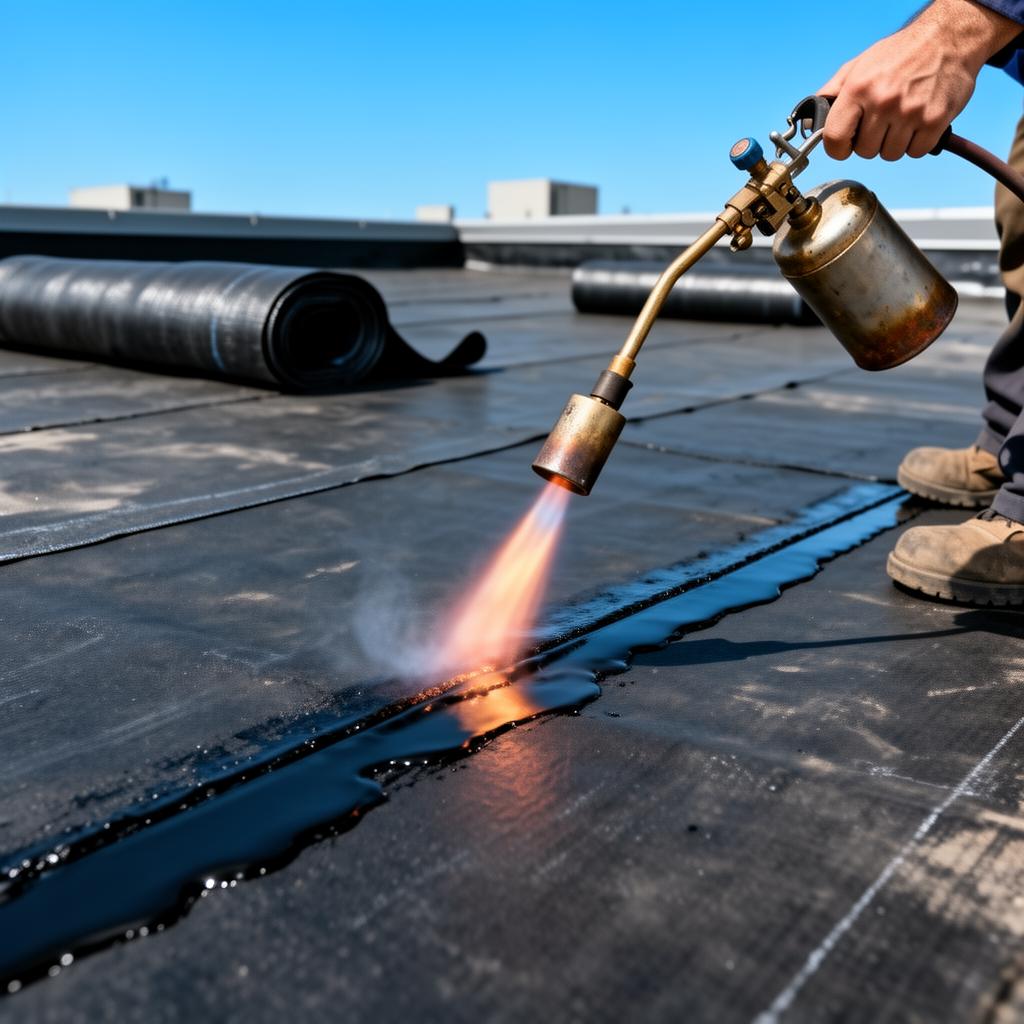
Torch-applied modified bitumen membrane — a typical use case for a modified bitumen roof calculator.
Hot mix is sold by the tonne, delivered by the truckload, and paid for on the spot. Order 10% short and the paver stops while a second truck is dispatched — that's a crew of five standing around at $80/hr each. Order 10% long and you pay for mix that gets dumped or wasted because asphalt has a ~2-hour workable window once it leaves the plant. So the job of any pavement calculator is less about precision to three decimals and more about not being out by 5–10%.
The same logic applies to roofing. Modified bitumen rolls come in fixed sizes (typically 1 m × 10 m for SBS/APP membranes, ≈ 10 m² per roll, sold in pallets). A modified bitumen roof calculator that undershoots by half a roll forces a second pallet delivery; one that overshoots leaves you with $400 of unused membrane and nowhere to store it. Tight estimates pay for themselves on the first project.
Asphalt vs bitumen vs modified bitumen roof calculator
There are three flavours of estimator and they're really three presets of the same formula:
Asphalt calculator (a.k.a. asphalt tonnage calculator, blacktop calculator, pavement calculator): reports total mix tonnage and cost for a driveway, parking lot or road. Optimised for people figuring asphalt by the square foot or square yard. Binder content is often hidden because the contractor cares about total tonnes ordered.
Bitumen calculator: the engineering variant — same inputs plus an explicit binder percentage, so you see how much of the mix weight is binder vs aggregate. This is what an asphalt estimator uses for tender pricing where binder cost moves with crude oil.
Modified bitumen roof calculator: swaps area-by-thickness for roof area × number of plies × roll coverage. Material is sold per roll, not per tonne, but the underlying maths is identical (area × layers × density-equivalent).
The calculator at the top of this page covers all three jobs. Use feet and inches for a US driveway, metres and millimetres for a road overlay, square feet for a flat-roof estimate — the unit dropdowns convert everything to SI internally before the maths runs.
How the bitumen and asphalt calculator works — inputs, outputs, formulas
Digital bitumen calculators streamline inputs, outputs and formulas on site.
Internally the tool runs five lines of arithmetic. Everything else is unit conversion and presentation.
Convert length, width, thickness to metres, and density to kg/m³.
Mix volume = L × W × T (m³).
Total mix weight = Volume × Density (kg), then ÷ 1,000 for tonnes.
Cost (if you entered a price/tonne) = Tonnes × Price.
Aggregate weight falls out for free: Total mix weight − Binder weight. The reason an asphalt tonnage calculator and a bitumen calculator look different on the surface is just which of these numbers you put front and centre — for a paving contractor, total tonnes is the headline; for a mix-design engineer, binder content is.
If you only have an area figure (square feet, square yards, square metres), use our Square Foot Calculator first to get to a clean area, then plug it back in with a thickness.
Figuring asphalt tonnage for a driveway, step by step
Say you're paving a typical US suburban driveway: 50 ft long × 12 ft wide, 2 inches of hot-mix asphalt on top of a compacted base. Here's the arithmetic the asphalt driveway calculator runs in the background:
Area = 50 × 12 = 600 ft² (≈ 55.7 m²).
Thickness = 2 in = 0.0508 m.
Volume = 55.7 × 0.0508 ≈ 2.83 m³.
Mix density (default HMA) = 2,350 kg/m³.
Total mix weight = 2.83 × 2,350 ≈ 6,650 kg → 6.65 tonnes.
At 5.5% binder, bitumen ≈ 0.37 t; aggregate ≈ 6.28 t.
A rule of thumb that matches this: about 110 kg of HMA per square metre at 50 mm thickness (≈ 24 lb/ft²). 600 ft² × 24 ≈ 14,400 lb ≈ 6.5 short tons — the same answer in imperial units, give or take rounding. Most US suppliers price by the short ton (2,000 lb), so when an asphalt estimator quotes you "about 7 tons" for a small driveway, this is the maths underneath.
Asphalt driveway cost estimator — what tonnage really costs
Material-only prices in the US sit roughly in the $100–$150/ton range for standard HMA at the plant gate, with regional swings tied to crude oil. Installed (material + labour + base prep + edging + compaction), most contractors quote $7–$13/ft² for residential driveways. Two comparisons using the 600 ft² example above:
Material only. 6.65 t × $125/t ≈ $830for the hot mix. That's what a blacktop driveway cost estimator reports if you bring your own labour.
Installed. 600 ft² × $10/ft² ≈ $6,000for a contractor pour over an existing base. New base prep adds $2–$4/ft² on top.
The calculator at the top lets you set price-per-tonne directly, which is the only number that actually moves your bill. Get a quote from two suppliers, pick the lower one, and the cost field is your check against their invoice.
Worked road example: blacktop calculator for a 1 km overlay
Scale this up to a council road job: a 1 km × 3.5 m carriageway getting a 50 mm overlay of dense-graded HMA at 5.5% binder, density 2,350 kg/m³. This is exactly the kind of estimate a pavement calculator or asphalt tonnage calculator is built for.
Volume = 1,000 × 3.5 × 0.05 = 175 m³.
Total mix weight = 175 × 2,350 = 411,250 kg → 411.25 tonnes.
Bitumen = 411.25 × 0.055 ≈ 22.62 t.
Aggregate = 411.25 − 22.62 ≈ 388.6 t.
Trucks needed (25 t bodies) = 411.25 / 25 ≈ 17 loads. Schedule them with the paver — don't let any sit more than 90 minutes.
The binder line item alone — 22.6 t at, say, $500–$700/t for PG 64-22 — is $11k–$16k. That's why bitumen estimates are tracked separately from the mix tonnage on any serious bid sheet.
Modified bitumen roof calculator — how many rolls do you need?
For flat commercial roofs, modified bitumen membranes (SBS or APP) are sold by the roll. Standard rolls are 1 m × 10 m (≈ 108 ft²), and most systems are installed as a two-ply build: a base sheet and a cap sheet.
For a 100 ft × 40 ft flat roof (4,000 ft² ≈ 371.6 m²):
Add ~10% for overlaps and waste at penetrations: ≈ 83 rolls.
Rounded up to the nearest pallet (20 rolls/pallet typical): order 5 pallets = 100 rolls.
The 10% waste factor is the line most amateur estimates miss — at flat roofs with lots of curbs, vents and HVAC bases, the practical waste rate is closer to 15%. Bump it up if the roof is busy. The same calculator handles this if you set "thickness" to the membrane thickness (3–4 mm per ply is typical) and use the membrane's specified density; it then reports total weight, which most roll suppliers also publish, so you can cross-check against the roll count.
Where bitumen estimates go wrong
After a few hundred estimates the same five mistakes show up over and over:
Measuring the parking lot from the plan, not the site.Drawings round; a real lot has bump-outs, broken corners and a kerb that's 1.6 m, not 1.5 m. Walk it with a wheel.
Using compacted thickness as loose thickness. Loose mix compacts ~20%. If the spec says 50 mm compacted, you spread closer to 60 mm loose. Most asphalt calculators (this one included) expectcompacted thickness — that's what's quoted to clients.
Wrong density. Open-graded friction course at 2,100 kg/m³ vs SMA at 2,450 kg/m³ is a 16% swing on tonnage. Confirm with your supplier's mix design sheet.
Mixed units. Length in feet, thickness in millimetres, density in lb/ft³ — every tool converts, but the operator still sometimes enters 50 (mm) where 0.05 (m) was wanted. Sanity-check the volume against a rough hand calculation.
Forgetting waste. Tack coat, joint overlap, paver screed-out, end-of-day cleanout — budget 3–5% on roads, 8–10% on driveways, 10–15% on busy flat roofs.
Tips from people who actually pour mix
Take the calculator's number to your supplier beforeordering. They'll spot a density or binder grade that doesn't match their stock and quote you the corrected tonnage.
On a phased job, run a separate calculation per phase. Aggregating a 6-day pour into one tonnage figure makes day-by-day delivery harder to schedule.
Use the same calculator (and same density) on every job. Estimating drift mostly comes from people switching tools mid-project.
For pricing, lock the binder rate in the quote. Bitumen pricing tracks crude oil, so a quote written in March may not hold in August. The cost field in this calculator is point-in-time.
Save the inputs. When the same client calls back next year for a second driveway, you'll want yesterday's numbers as your starting point — not a fresh start from memory.
RAP, warm-mix and sustainable bitumen choices
The single biggest sustainability lever in paving is Reclaimed Asphalt Pavement (RAP) — milling existing asphalt off a road, screening it, and re-blending it into new mix. Federal Highway Administration data puts average RAP content in US HMA mixes at around 21%, with some state DOTs allowing 30%+. Higher RAP means lower virgin bitumen demand, which is both cheaper and lower-carbon.
Warm-mix asphalt (WMA) is the other big lever. It uses additives or foaming to lower production and laydown temperatures by 30–50 °C, cutting plant fuel use and on-site emissions without changing the calculator inputs at all — same density, same binder %, same tonnes. Polymer-modified binders (SBS, EVA) trade a little upfront cost for a longer pavement life, which is the sustainability story that actually pencils out on a 20-year lifecycle.
None of this changes how you run the maths — it changes which mix design you specify. Plug the resulting density and binder % from your supplier's mix sheet into the calculator and the tonnage shakes out the same way.
Q&A
Q1
How do I choose between an asphalt calculator, a general bitumen calculator, and a modified bitumen roof calculator?
A
Short answerMatch the tool to your project type and materials. Use an asphalt calculator for paving roads, parking lots, and pathways where you estimate the full asphalt mix. Pick a general bitumen calculator for versatile uses where the focus is on bitumen quantity across various construction tasks. Choose a modified bitumen roof calculator for flat roofing projects that require roof dimensions, layer counts, and specific modified bitumen types. Selecting the right tool improves accuracy, reduces waste, and supports budget control.
Q2
What inputs matter most for accurate estimates, and how are they used in the formulas?
A
Short answerArea, layer thickness, material type, and density drive accuracy. Calculators convert these into quantity using two core steps: Volume = Area × Thickness, then Mass = Volume × Density. Precise measurements, correct density for the chosen bitumen or mix, and consistent units (metric or imperial) are essential to avoid over- or under-ordering.
Q3
How should I account for environmental conditions and material quality in my calculations?
A
Short answerAdjust estimates to reflect real-world conditions. Temperature, weather, and site specifics can change how bitumen behaves and how much is needed. Verify material properties (e.g., density variations, polymer-modified behavior), consider local climate (hot/cold cycles), and factor in project nuances during the review-and-adjust stage. Site visits and stakeholder validation help refine inputs before finalizing quantities.
Q4
What common mistakes cause inaccurate bitumen estimates, and how can I avoid them?
A
Short answerFrequent pitfalls include incorrect area/thickness measurements, wrong density assumptions, mixed units, unaccounted design changes, and manual data-entry errors. Prevent them by double-checking dimensions, using verified material data, keeping units consistent, revising calculations when scope changes, and leveraging digital tools to minimize manual entry. Document assumptions to streamline reviews and future updates.
Q5
How do digital calculators, software integration, and AI/ML improve planning and execution?
A
Short answerDigital tools increase accuracy and speed, reduce human error, and streamline workflows. Integration with construction management systems enables real-time updates, data synchronization, and automation (e.g., seamless transfer of estimates to procurement). Emerging AI/ML enhances predictions by learning from past projects and adapting to changing conditions, enabling better risk management, tighter budgets, and fewer delays.
Bitumen & asphalt reference tables
Grade selection, mix-design percentages, density, gradation, working temperatures, coverage and cost — the engineering numbers behind every paving estimate.
Common bitumen grades & uses
Grades
Grade
Penetration
Typical use
VG-10
80–100
Spray application, low-traffic
VG-20
60–70
Cold-climate paving
VG-30
50–70
Most highway paving
VG-40
30–50
Heavy-traffic, hot regions
PMB-40
Polymer-modified
Airports, expressways
Binder content by mix type
Mix design
Mix type
Binder %
Layer thickness
Dense Bituminous Macadam (DBM)
4.0 – 4.5%
50–100 mm
Bituminous Concrete (BC)
5.0 – 6.0%
25–50 mm
Stone Matrix Asphalt (SMA)
5.8 – 7.0%
30–50 mm
Open-Graded Friction Course
5.5 – 6.5%
20–25 mm
Cold mix (patching)
4.0 – 5.0%
Variable
Mastic asphalt
8.0 – 10.0%
20–40 mm
Compacted asphalt density
Density
Mix
kg/m³
lb/ft³
DBM
2350
146.7
Bituminous Concrete
2400
149.8
Stone Matrix Asphalt
2450
152.9
Open-Graded Mix
2150
134.2
Mastic asphalt
2300
143.6
Recommended pavement thickness (mm)
Thickness
Application
Min
Max
In inches
Driveway (residential)
50
75
2.0–3.0″
Parking lot (light)
60
100
2.4–3.9″
Parking lot (heavy truck)
100
150
3.9–5.9″
City street
75
125
3.0–4.9″
Highway base course
100
200
3.9–7.9″
Highway wearing course
40
50
1.6–2.0″
Airport runway
150
300
5.9–11.8″
Sieve gradation (% passing)
Aggregate
Sieve size
DBM
Bituminous Concrete
26.5 mm
100
—
19.0 mm
90–100
100
13.2 mm
59–79
79–100
9.5 mm
52–72
70–88
4.75 mm
35–55
53–71
2.36 mm
28–44
42–58
0.30 mm
8–18
12–24
0.075 mm
2–8
4–10
Mixing & compaction temperatures (°C)
Temperature
Grade
Mixing
Compaction
Risk
VG-10
150–165
140–155
Standard
VG-30
160–175
150–165
Standard
VG-40
165–180
155–170
Watch
PMB
170–185
160–175
Watch
Mastic
200–230
Hand-spread
Hazard
m² covered per tonne (2,400 kg/m³ mix)
Coverage
Thickness
m² / tonne
ft² / ton
25 mm
17.0
183
40 mm
10.6
114
50 mm
8.5
91
75 mm
5.7
61
100 mm
4.3
46
150 mm
2.8
30
Typical asphalt cost breakdown
Cost
Component
Share
%
Bitumen binder
30%
Coarse aggregate
35%
Fine aggregate
15%
Filler & additives
5%
Plant & energy
8%
Transport & laying
7%
Frequently asked questions
What is the formula for bitumen calculation?
Bitumen quantity = Length × Width × Thickness × Mix Density × (Bitumen % ÷ 100). The product Length × Width × Thickness gives the mix volume in m³, multiplied by mix density (typically 2,300–2,400 kg/m³) gives the total mix weight in kg, and the bitumen percentage isolates the binder weight.
How to calculate bitumen content in asphalt?
Bitumen content is expressed as a percentage of total mix weight. Formula: Bitumen % = (Bitumen Weight ÷ Total Mix Weight) × 100. Most dense-graded hot mix asphalt runs 4.5%–6.0%, Stone Matrix Asphalt 5.8%–7.0%, and mastic asphalt 8%–10%. Use your approved mix design when available — the calculator above lets you set the binder percentage directly.
How to calculate bitumen quantity for a road?
Multiply road length × width × pavement thickness to get the mix volume in m³, then multiply by compacted mix density (typically 2,350 kg/m³) to get total mix weight in tonnes, then multiply by the binder percentage. Example: a 1 km × 7 m road with 50 mm of BC mix at 5.5% binder = 1000 × 7 × 0.05 × 2.4 t/m³ × 0.055 ≈ 46.2 tonnes of bitumen.
What are typical bitumen spray rates for chip seal?
Single chip seal applications typically use 0.9–1.6 L/m² of emulsified bitumen, depending on aggregate size, road texture and traffic. Common starting points: 14 mm chips ≈ 1.3–1.5 L/m²; 10 mm chips ≈ 1.1–1.3 L/m²; 7 mm chips ≈ 0.9–1.1 L/m². Adjust for residual binder content (emulsions are usually 65–70% bitumen by weight).
How do I calculate asphalt tonnage for a driveway?
Multiply driveway area (m² or ft²) by thickness, then by compacted asphalt density. In metric: tonnage = length(m) × width(m) × thickness(m) × 2.35. In imperial: a 50 mm (2 inch) asphalt driveway uses about 110 kg/m² or 24 lb/ft². For a 50 m² (≈540 ft²) driveway at 50 mm, that's roughly 5.5 tonnes of hot mix.
What mix density should I use?
Hot mix asphalt (HMA) typically has a compacted density of 2,300–2,400 kg/m³ (about 144–150 lb/ft³). Use the value from your approved mix design when available; the calculator defaults to 2,350 kg/m³, a common industry average.
What is a typical bitumen content percentage?
Most asphalt mixes contain 4.5%–7% bitumen by weight. Dense-graded HMA usually runs 5.0%–6.0%, Stone Mastic Asphalt 6.0%–7.0%, and polymer-modified mixes for heavy-duty pavements 5.5%–7.0%.
How is the aggregate quantity calculated?
Aggregates make up the remainder of the mix after bitumen. The calculator subtracts the bitumen weight from the total mix weight: Aggregate Weight = Total Mix Weight − Bitumen Weight.
Can I estimate the project cost?
Yes. Enter a price per tonne and the calculator multiplies it by the total mix weight in tonnes to give an estimated material cost. This is a planning estimate only and excludes labour, equipment, transport and overheads.
Does the calculator handle imperial units?
Yes. Length and width support metres, feet and kilometres. Thickness supports millimetres, centimetres, metres and inches. Mix density supports kg/m³ and lb/ft³ — all inputs are converted to SI units before calculation.


 Hannah Brooks