

 Hannah Brooks
Estimating concrete block for a wall: how many you need, and what else to order
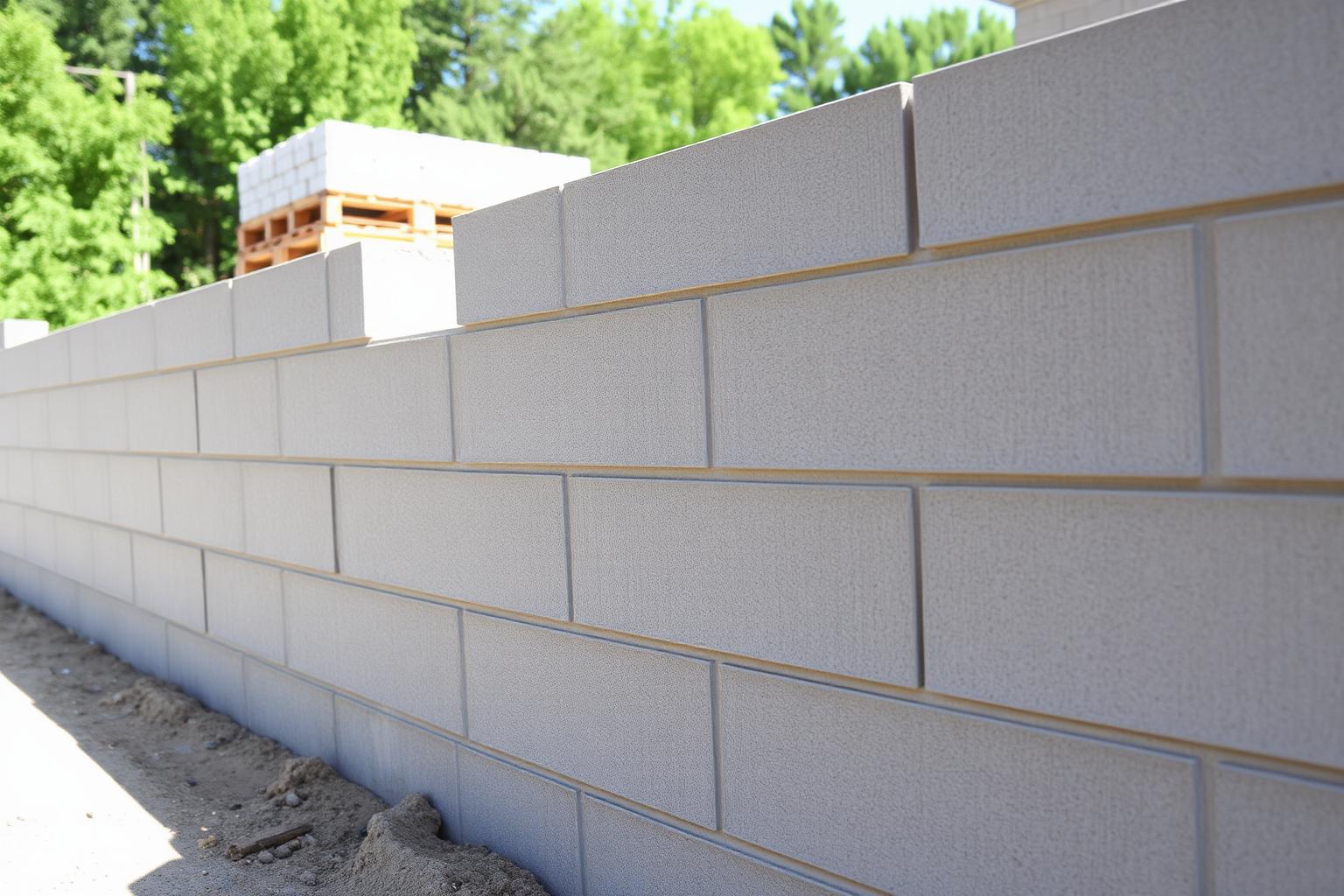
Estimating concrete block for a wall: how many you need, and what else to order
Most masonry projects fail at procurement before they fail at construction. You order too few blocks and lose three days waiting on a redelivery; you order too many and you've got a literal ton of unusable inventory blocking your driveway for a month. I've done both. The math to avoid both isn't hard, but it has six or seven moving pieces — block count, mortar, rebar, grout, waste factor, the corner blocks and half blocks people forget about — and missing any one of them is an unpleasant phone call to the supply yard.
What follows is the actual estimation process, with numbers and the gotchas. The default assumption is that you're working with standard 8x8x16 concrete masonry units on a residential or light commercial wall. Most of the formulas scale to other block sizes if you swap dimensions, but the rules of thumb (mortar bags per 100 blocks, waste factor percentages) are calibrated to the 8-inch standard.
Cinder block vs. concrete block
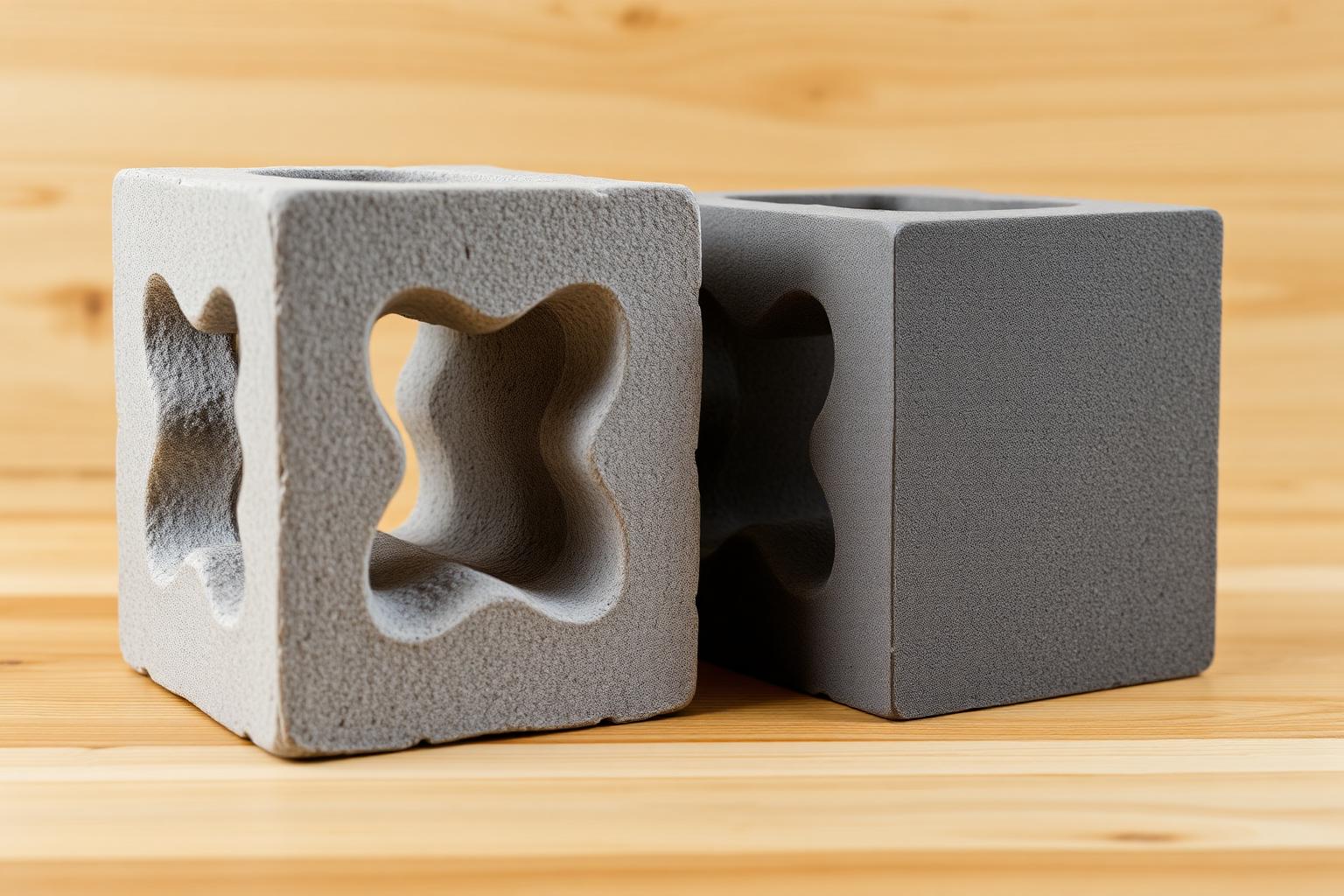
A bit of disambiguation first because the terms get used interchangeably and it actually matters. A true cinder block uses coal ash as the aggregate — it's lighter, weaker, and effectively obsolete. Most building codes don't allow them for structural use, and most manufacturers stopped producing them decades ago. What's labeled "cinder block" at a Home Depot or Lowe's is almost always a concrete masonry unit, or CMU, which uses crushed stone or sand as the aggregate.
Anything load-bearing is going to be CMU regardless of what the store calls it. A standard 8x8x16 CMU weighs somewhere between 35 and 40 pounds, runs $1.50 to $3.00 at retail, and has compressive strength of 1,900 to 3,000 psi depending on grade. True cinder blocks, when you can find them, are for non-load-bearing decorative work — garden walls, planters, the kind of thing that's never going to hold up a roof.
Why nominal sizes aren't actual sizes
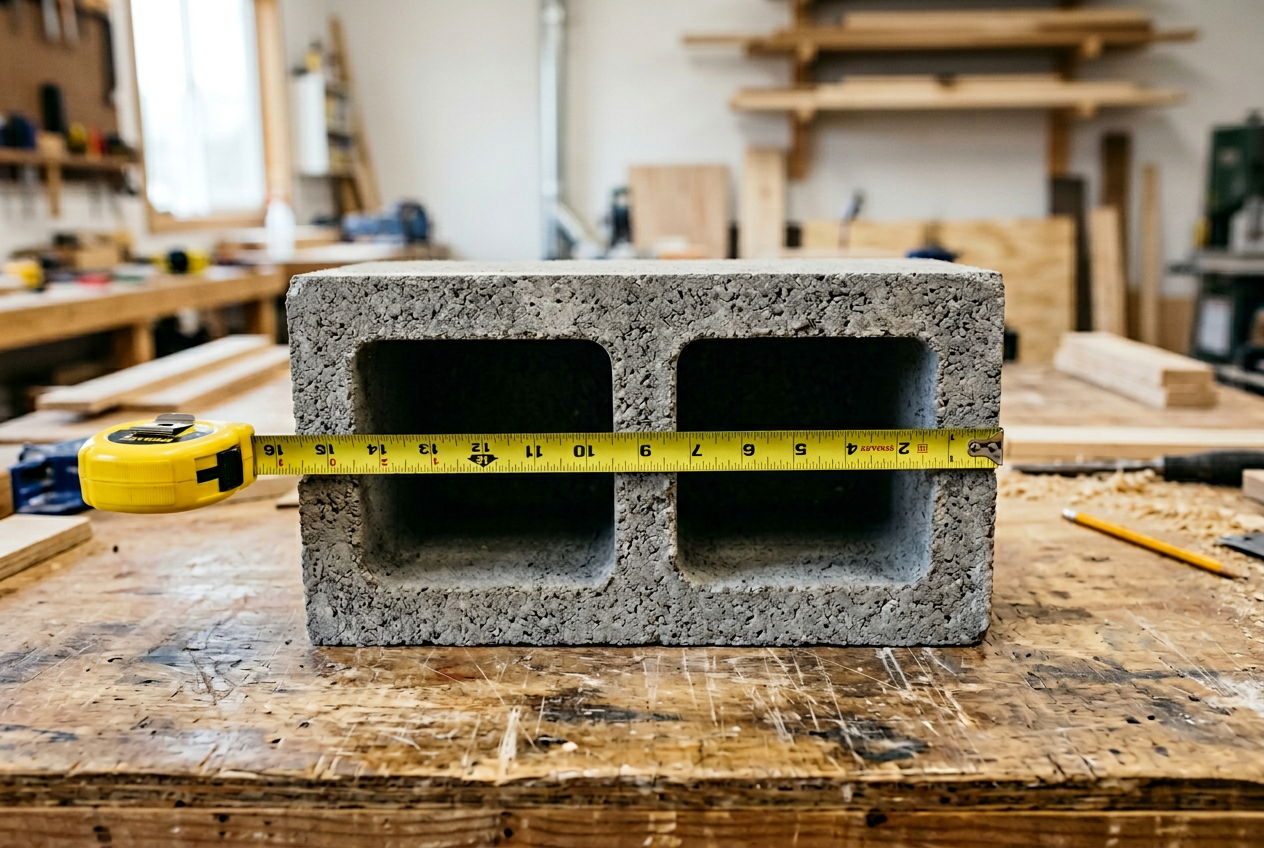
A 16-inch block isn't 16 inches long. Pull one off a pallet and measure it and you'll get 15 5/8 inches. The 3/8-inch difference is the mortar joint, which gets factored back in as the block sits in the wall. Same story with the 8-inch height — actual block is 7 5/8 inches plus a 3/8-inch bed joint. The 8-inch width (depth into the wall) is just 7 5/8 inches with no joint, since the wall isn't joined on its sides.
This sounds pedantic until it stops being pedantic. Every standard wall calculation runs against nominal sizes, not actual ones, because the nominal size is what each block effectively occupies once it's mortared. If you measure a block, get 15 5/8 inches, and use that number, your wall comes up almost an inch short every six or seven blocks. I've seen people dry-stack blocks for a fence project assuming the actual dimensions were the real numbers, and the math came out so wrong they thought the blocks had been mismanufactured.
Other sizes you'll run into: 4-inch blocks (4x8x16 nominal) are non-load-bearing, used for partition walls and brick veneer applications. 6-inch is for short retaining walls and lighter single-story construction. 10-inch and 12-inch are heavy-duty — foundations supporting multi-story buildings, deep basements, commercial walls. The face dimensions stay 8x16 across all of them, so the per-square-foot block count doesn't change, but everything else does. A 12-inch block can hit 60 pounds, uses considerably more mortar per joint, and holds nearly twice as much grout per core as an 8-inch.
Blocks per square foot
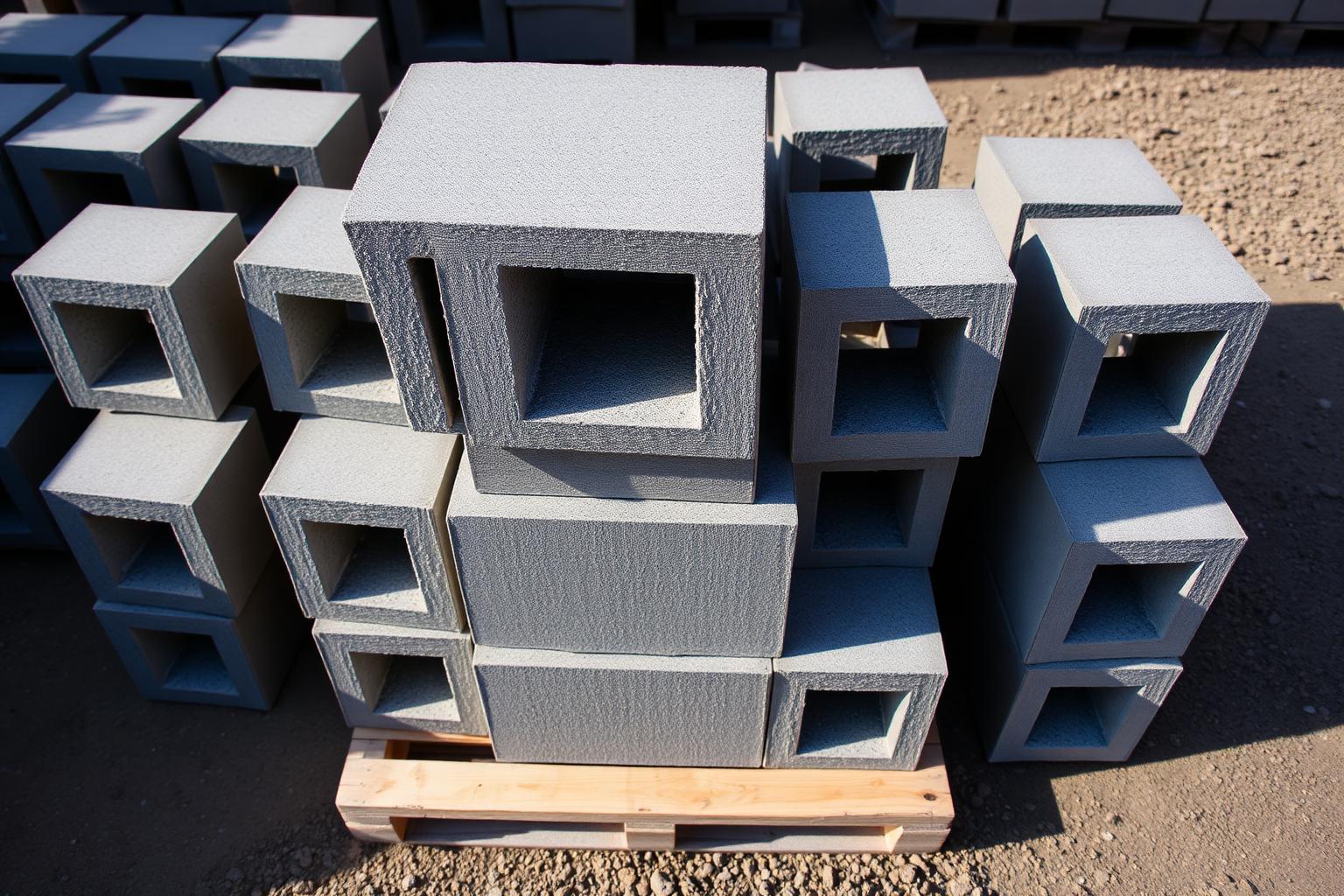
A nominal block face is 16x8, which is 128 square inches. A square foot is 144 square inches. So a square foot of wall takes 144/128 = 1.125 blocks.
For a 30-foot wall that's 10 feet tall: 30 × 10 = 300 sq ft of wall × 1.125 = 337.5 blocks before you subtract for openings.
Subtracting openings
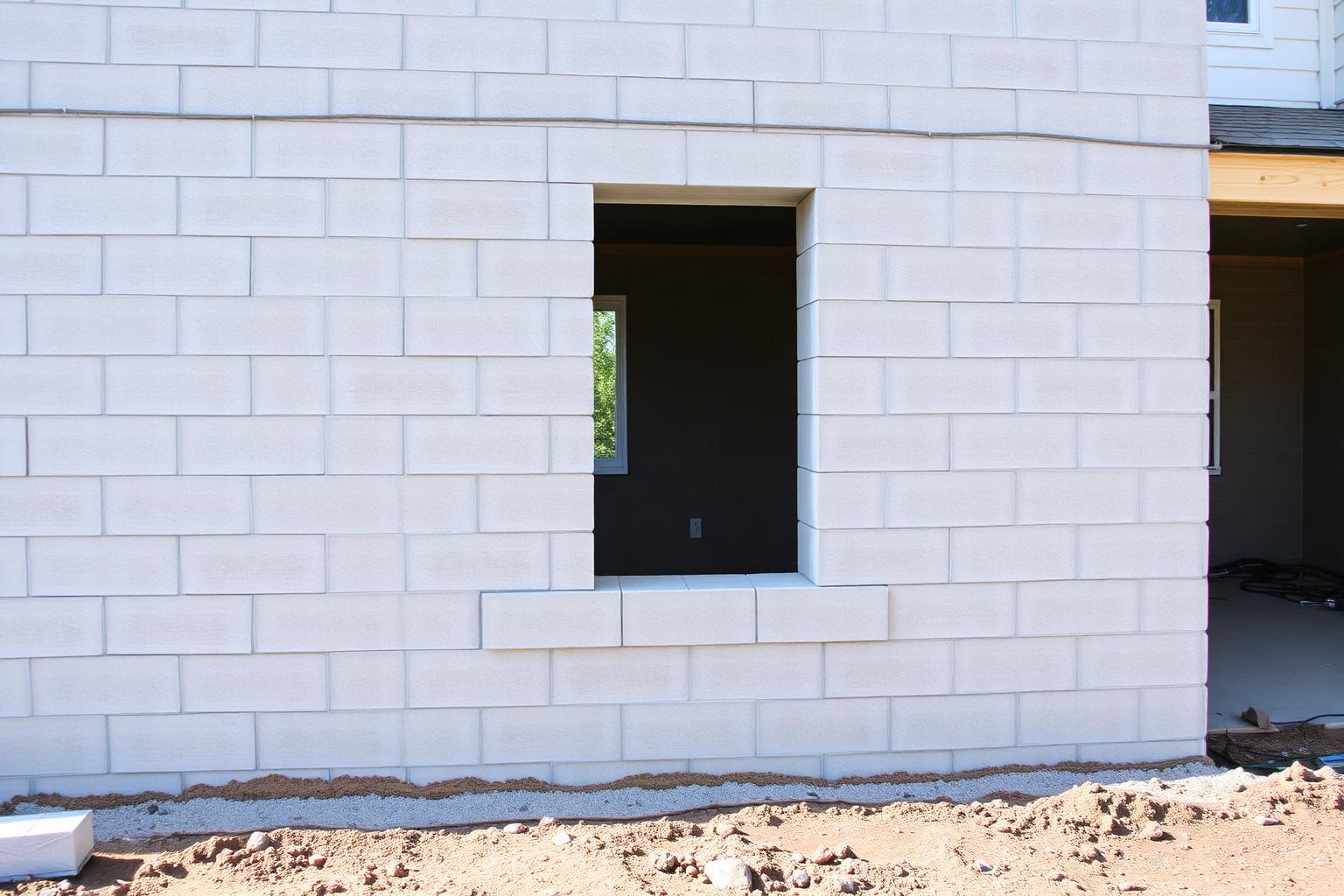
Doors and windows are voids in your wall and you don't lay block where they go. Calculate the square footage of each opening and subtract from your gross.
A 4-foot wide by 3-foot tall window is 12 sq ft. A 3x7 standard door is 21 sq ft. Subtract both from your 300 sq ft gross and you get 267 sq ft of net wall area. Multiply by 1.125 and you're at 300.4 blocks — round up to 301. The mistake people make here is forgetting smaller openings: vents, electrical penetrations, the gap above a window where a header sits. Individually each one is two or three blocks, but on a complex wall with five or six of them, the math drifts.
Waste factor
Blocks chip during transport, get cracked when they're being cut around plumbing, and occasionally get dropped while being set. You need to order more than your math says, and the standard amount more is 5%. So a 301-block wall becomes a 316-block order.
For complex projects with lots of cuts — multiple corners, gables, irregular openings, archways — bump the waste factor to 10%. Mortar gets its own waste factor, which is higher because a meaningful percentage of any batch ends up on the ground or in a wheelbarrow that didn't get used in time. Plan for 10% mortar waste minimum.
Corner blocks and half blocks
A standard wall isn't built with all stretcher blocks. Walls are laid in a "running bond" pattern where vertical joints in adjacent courses are offset, which means every other course terminates with a half block at the end. And anywhere two walls meet at a 90-degree corner, you need corner blocks — they have a smooth finished end instead of the recessed end that stretcher blocks have.
For corners, count one corner block per course per corner. A 10-foot tall wall is 15 courses (120 inches divided by 8), so each corner needs 15 corner blocks. A four-corner room needs 60.
For half blocks at openings, you need one every other course on each side of the opening. A 7-foot tall door is roughly 10.5 courses, so figure 5 to 6 half blocks per side, or 10 to 12 per door.
You can cut a stretcher block in half on site with a masonry saw, which works fine if the cut end is going to be hidden — buried in another wall, behind drywall, that kind of thing. If the cut end is exposed, the inside of the block shows and it looks like exactly what it is, a block somebody sawed in half. Order factory half blocks for visible terminations.
Mortar
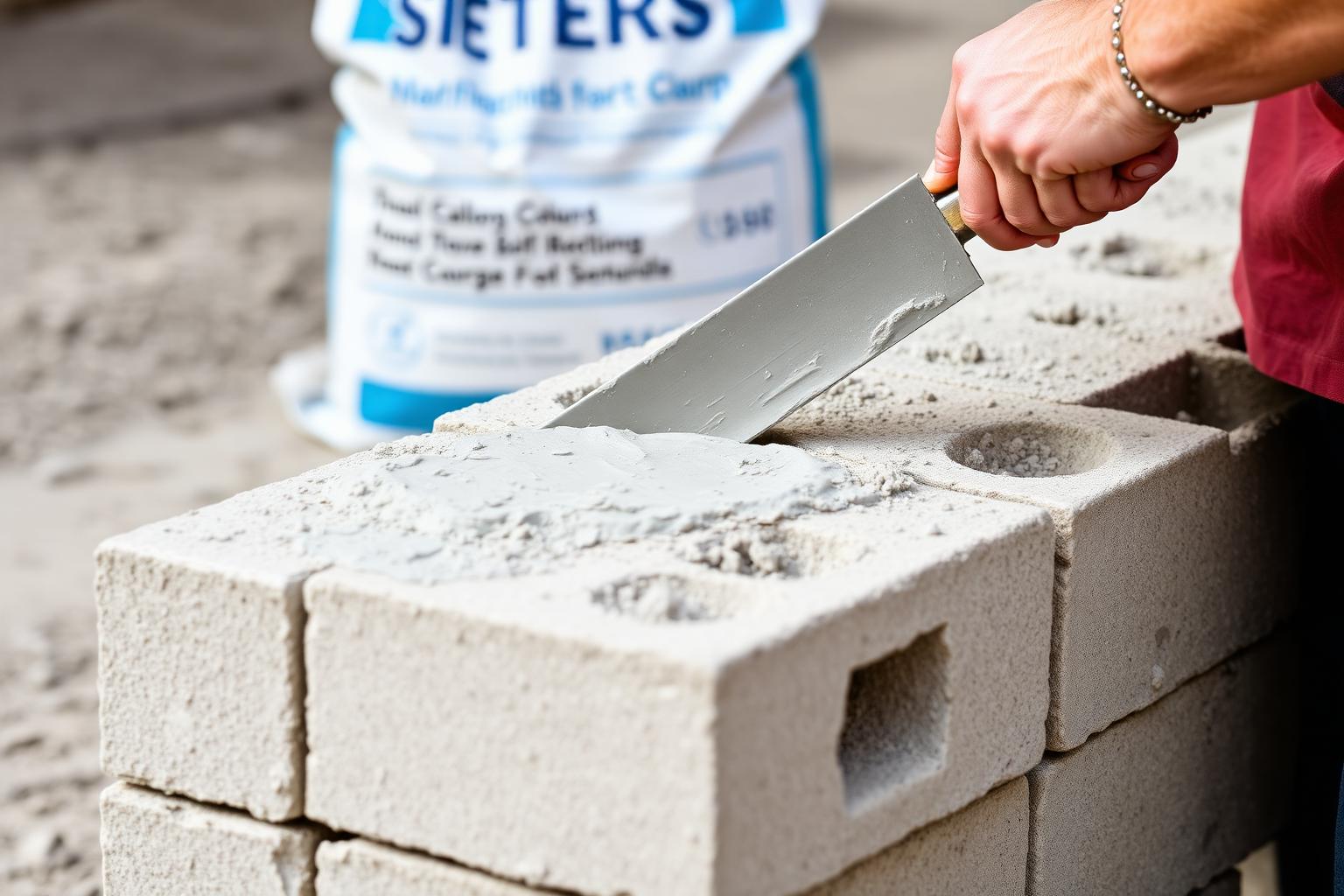
About 3 bags of 70-pound pre-mixed mortar per 100 blocks is the rule of thumb most masons use. It's on the higher end of typical industry numbers (some sources cite 2.5), so it has some implicit waste built into it, which is fine because mortar waste is real. For our 301-block example, you're looking at 9 to 10 bags. Round up to 10. At $8 to $12 a bag, that's $80 to $120 in mortar alone.
Mixing your own from scratch is genuinely cheaper for big jobs, but the savings start mattering somewhere north of 500 blocks and assume you've got the equipment to mix on site. The standard Type S ratio by volume is 2 parts Portland cement, 1 part hydrated lime, 9 parts masonry sand. To lay 100 blocks you need around 3.5 cubic feet of mortar, which works out to roughly one 94-pound bag of Portland, half a bag of hydrated lime, and a wheelbarrow's worth of clean masonry sand.
Quick note on mortar types because people get this wrong constantly. Type N is for general above-grade work — wrong choice for foundations or anything below grade. Type S is the workhorse for most structural masonry and what you should default to. Type M is higher strength than you typically need outside of heavily-loaded retaining walls and below-grade foundations in saturated soil. Type O is for repointing historic brick. Don't use Type O for new construction. I've seen this mistake on a job site once and it's expensive to undo.
Rebar and core-fill grout
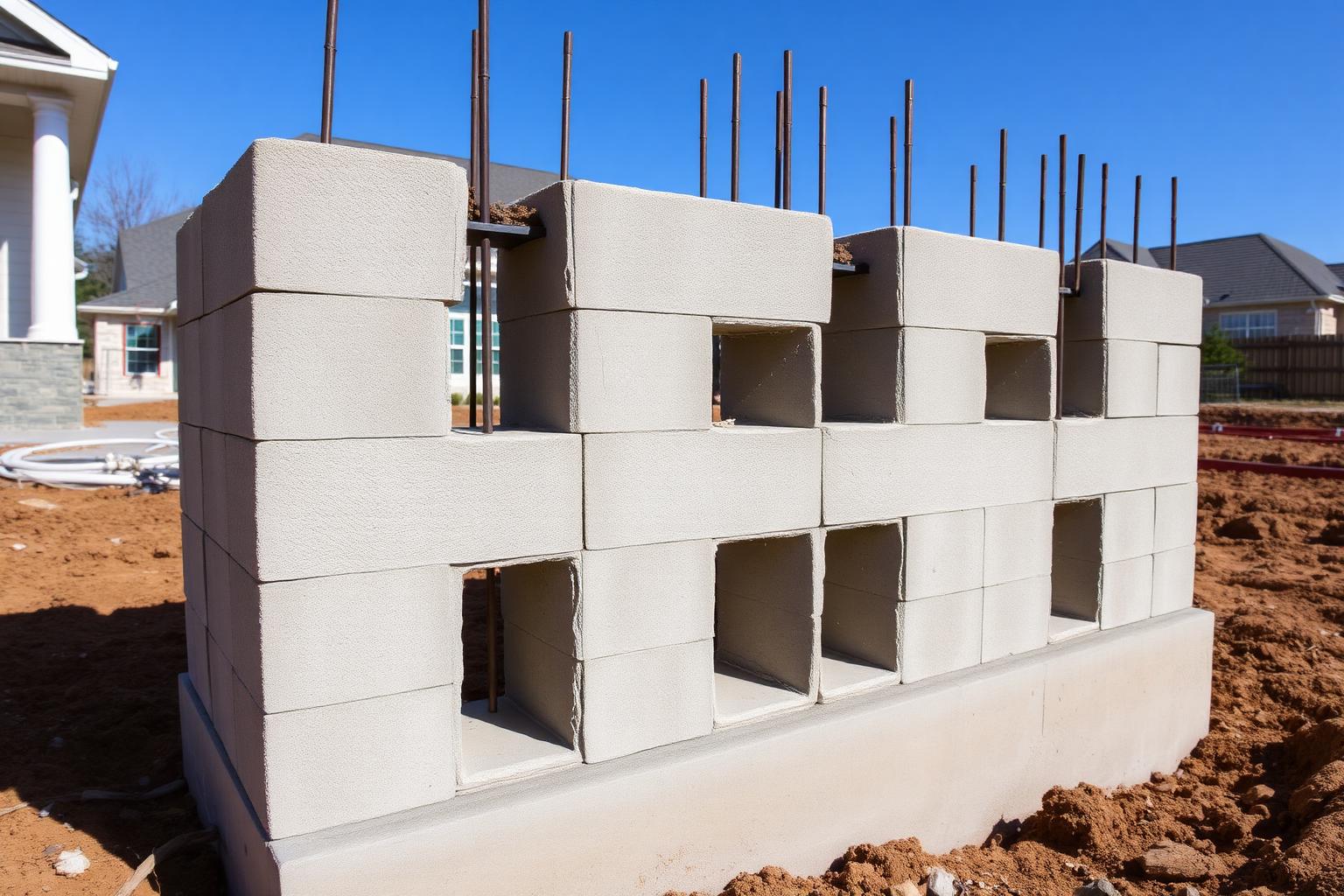
A wall that's just blocks and mortar is fine in compression — it can carry weight pushing straight down — but it's weak in tension and lateral loading. Wind, seismic forces, and especially soil pressure on a retaining wall will crack and topple a wall without steel reinforcement.
The reinforcement is rebar set vertically into the foundation and running up through the hollow cores of the blocks, with horizontal rebar in bond beam courses, plus grout filling the cores that contain rebar so that the steel and the masonry act as one structural system. Spacing is dictated by code and by your engineer's plans, not by guesswork.
For residential work, vertical rebar typically runs every 16, 24, 32, or 48 inches along the wall, with closer spacing for taller walls and walls retaining more soil. A 30-foot wall with rebar every 16 inches needs about 23 vertical bars (360 / 16, plus one for the end). A 10-foot wall height means 230 linear feet of rebar before laps.
Lap splices are the part that catches people. When two pieces of rebar are joined end-to-end, they have to overlap, and the overlap eats material you might not have budgeted for. The general rule for #4 (1/2") bar is about 20 inches of overlap, though the exact requirement varies with bar grade and jurisdiction — some codes require more, some less, and your engineer's plans will be specific. I'd add 10 to 15% to your linear footage to cover laps, and verify the actual spec before ordering.
Core-fill grout
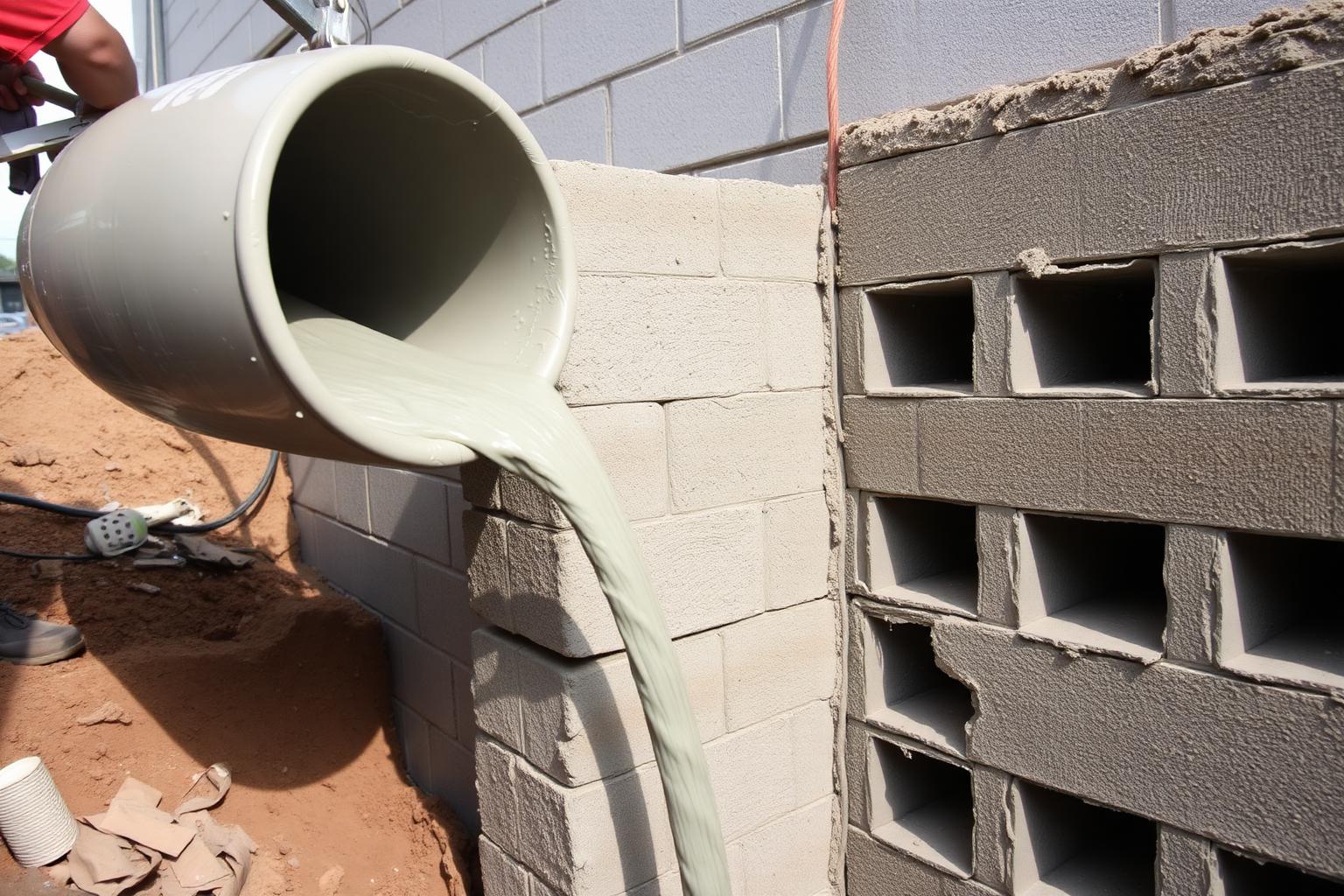
Once the rebar's in and the blocks are laid, the cores containing rebar get pumped full of grout. This is a high-slump concrete mix that locks the steel and masonry into one structural system, and getting the volume right is where the budget lives. Over-order and you're paying minimum-charge fees on ready-mix delivery for grout that goes nowhere; under-order and you're stopping work to schedule a second pour.
A standard 8x8x16 hollow CMU has about 0.25 cubic feet of void space, give or take, depending on the manufacturer and the face shell thickness. If you're filling every core in a 300-block wall, that's 75 cubic feet, divided by 27 (cubic feet per cubic yard) gives you about 2.8 cubic yards.
Most residential walls don't fill every core, though, and this is where reading the engineering plans matters. If the spec is to fill only the cores containing rebar — typical at, say, 32 inches on center — you're filling roughly half the cores, which cuts your grout volume to something like 1.4 cubic yards. The cost difference between "every core" and "rebar cores only" can be a thousand dollars on a residential job. Don't guess at this; check the plans.
Ready-mix delivery is $130 to $180 per cubic yard depending on region, plus short-load fees if you order less than 3 or 4 yards. For very small jobs, mixing grout on site from bagged concrete is sometimes cheaper, though once you account for the labor and the messiness of pumping bagged grout into block cores, the savings often disappear.
Retaining walls have their own rules
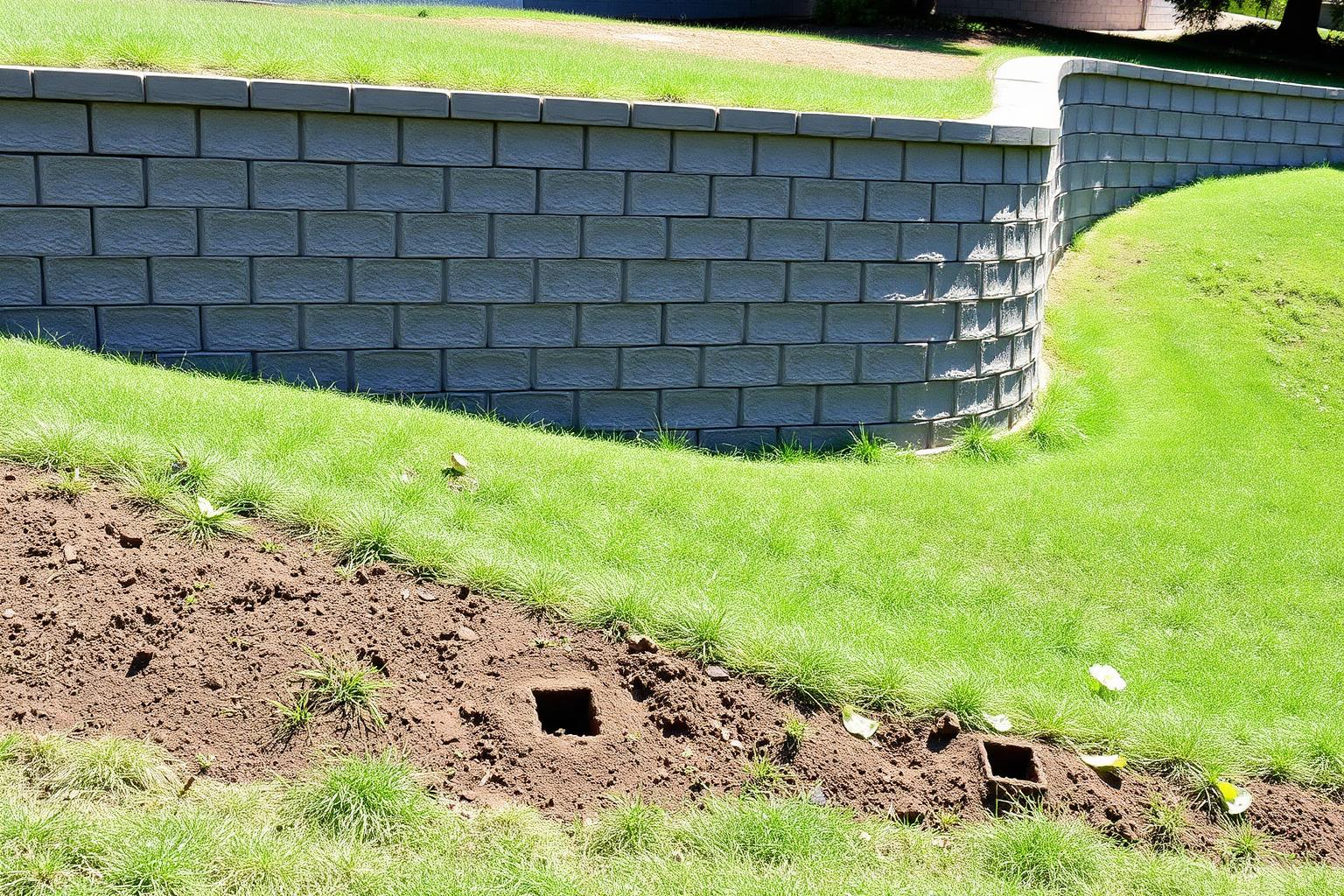
Retaining walls hold back tons of soil and water, and they fail in different ways than freestanding walls. A few things change the block math:
Retaining walls are often built with a slight backward lean (called batter) toward the soil they're retaining, which doesn't change the block count much but does affect how you lay out the footing.
You need weep holes at the bottom course to let water drain out from behind the wall. These are typically blocks where mortar is omitted from a vertical joint, or short pieces of pipe set into the wall during construction. Hydrostatic pressure from undrained soil is one of the most common reasons retaining walls fail, and it's preventable.
Taller retaining walls often need deadmen or geogrid tiebacks anchoring the wall back into the hillside. These add blocks and complicate the calculation, and anything over about 4 feet tall really should be designed by an engineer rather than estimated off a calculator.
Foundations
Foundation walls have to start below the local frost line, which varies by region. In most of the northern US, the frost line is 36 to 48 inches; in the south, it can be a foot or less. Below grade, you're using more blocks than the visible wall would suggest.
If the frost line in your area is 36 inches, that's at least 5 courses of below-grade block before you even reach ground level. Multiply that by your wall length and you've added a meaningful number of blocks to a calculation that started by measuring the visible portion of the wall.
If you're building on a slope, you'll need step footings that staircase down with the grade. Each step section needs to be calculated separately because the block count varies — the section over deep ground needs more courses than the section over shallow ground.
A short digression on getting this wrong
Worth being honest that I've miscalculated this stuff myself, and I'm not going to pretend the article was written by someone who's never had a problem.
The worst one was a small basement wall a few years ago — maybe 40 feet of foundation, 8 feet tall — where I'd done the block math fine but I underordered grout because I was filling alternate cores and somehow convinced myself that was every fourth core. So my volume math was off by a factor of two. The pour started at 7 AM on a Saturday, the truck was scheduled for an hour, and I ran out of grout while the mason was still on the second wall. He was a friend and was very kind about it. The second truck couldn't come until Monday because of how the dispatch worked, which meant the partial pour cured before the next one could go in, which meant we had a cold joint where there wasn't supposed to be one, which the inspector flagged, which meant a conversation with the engineer about whether we needed to break the wall apart and start over. We didn't, in the end — the inspector accepted some additional surface preparation and a chemical bonding agent — but it cost two extra days, $400 in remediation materials, and a real amount of dignity.
The lesson, mostly, is that "I'll just figure out the grout when I get there" is the moment you should slow down. Read the plans twice. Ask the engineer if you're not sure whether "alternate cores" means every other one or every fourth one or every block with rebar in it. Order more than you think you need; the leftover at the end is a much smaller problem than the shortage in the middle.
Anyway. Back to it.
When to use thicker blocks
The default 8-inch CMU works for single-story residential walls and foundations holding back less than 4 feet of soil. It's not enough for everything.
Basement walls retaining 6 to 8 feet of heavy clay, multi-story commercial work, walls supporting big point loads — these usually need 10-inch or 12-inch blocks. The face dimensions stay 8x16, so your per-square-foot block count is unchanged. What changes is everything else. The wider blocks weigh more per unit, so your delivery is heavier and labor is harder. The bed surface is larger, so each joint takes more mortar. The cores are bigger, so your grout volume goes up — a 12-inch block holds about 0.45 cubic feet of grout per block, almost double the 8-inch. A wall that switches block thickness from 8" to 12" can roughly double its grout order, which is usually the budget surprise that catches people.
What things actually cost
Pricing is the section most likely to be wrong by the time you read this, because lumber and concrete prices move with regional supply, fuel costs, and global aggregate availability. Treat the numbers below as orders of magnitude, not quotes. Get current prices from your local supply yard before you finalize a budget.
Standard 8x8x16 CMUs run $1.50 to $3.00 each at retail, dropping to $1.20 to $2.00 at masonry yards if you're buying by the pallet. Type S mortar in 70-pound bags is $8 to $12. A 10-foot length of #4 rebar runs $6 to $9. Ready-mix grout delivered is $130 to $180 per cubic yard, with short-load fees that can add $100 or more on small orders.
Materials cost per square foot of wall, roughly: blocks at $2.25, mortar at $0.40, rebar at $0.50, grout at $1 if you're filling cores at 32" on center. So $4 to $5.50 per square foot for materials, which puts a 300-square-foot garage wall in the $1,200 to $1,650 range. The spread is wide because grout volume is the variable — fill every core and the materials cost can climb 30 or 40 percent.
Labor
Labor's the bigger cost when you're hiring. Masons charge by the block or by the square foot, in the neighborhood of $7 to $12 per block laid or $8 to $15 per square foot. Combined with materials, professionally contracted work runs $12 to $25 per square foot. A 300-square-foot garage wall that costs $1,500 in materials becomes a $4,500 to $7,500 contracted project. This gap is most of why people learn block math in the first place — the labor savings on a DIY job are large enough to justify the time investment, assuming you actually have the skill to lay block cleanly.
Logistics on delivery day
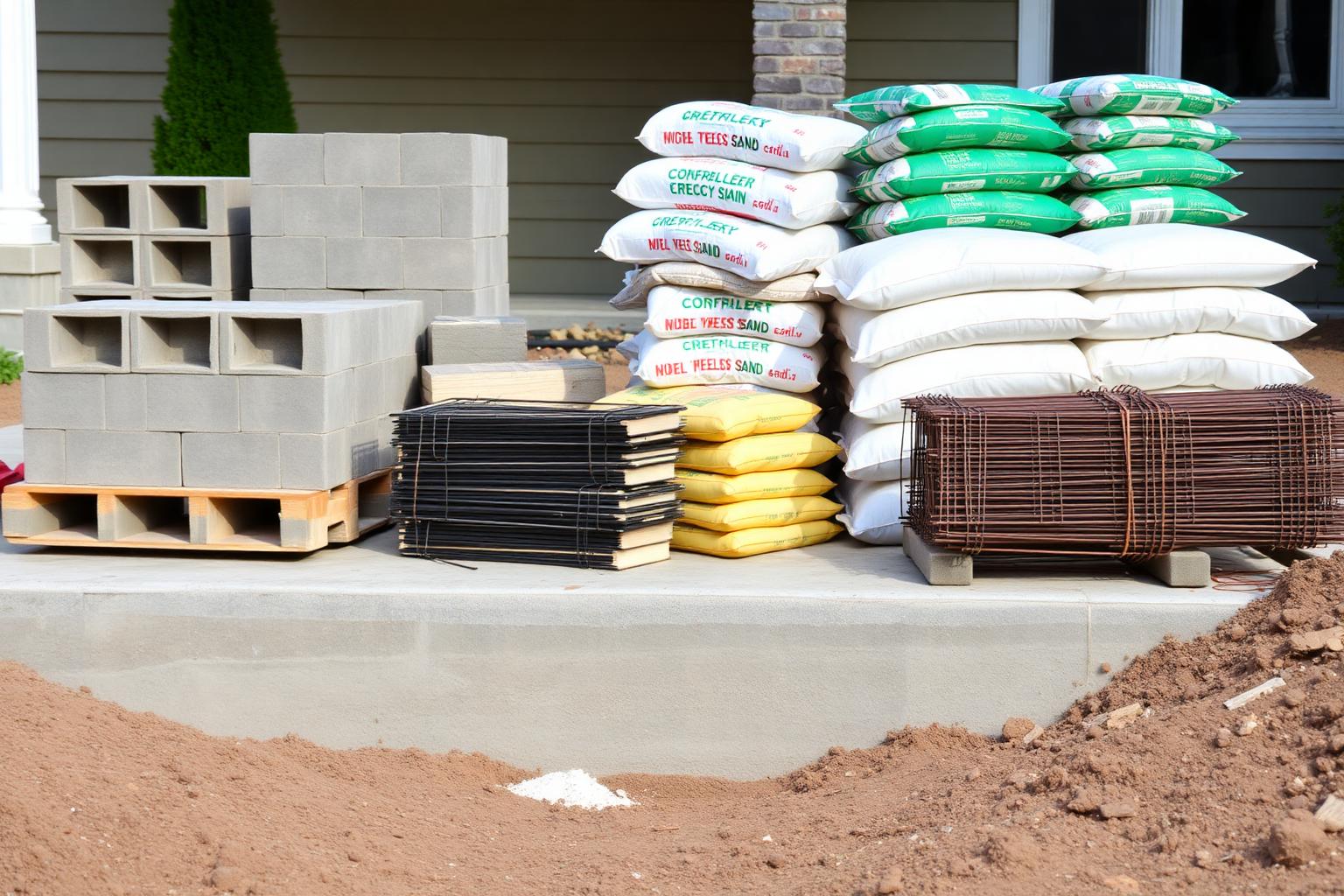
This is the part that doesn't show up in the calculator math but matters more than the calculator math does. When the truck pulls up with 320 blocks, two tons of sand, and a pallet of mortar, where it gets dumped affects how exhausted you'll be in three days.
Don't let the driver dump everything in one pile. Have him space the pallets along the length of the footing so you're never carrying a 40-pound block more than ten feet to set it. Three to four feet back from the wall line is usually about right — close enough to grab without walking, far enough that you can still set up scaffolding and walk a wheelbarrow through.
Set up the mortar mixing station centrally. Middle of the wall for long runs so the wheelbarrow trip to either end is roughly equal. Cement bags go on wooden pallets, covered with tarps. A single rainstorm on uncovered cement turns hundreds of dollars of materials into useless rocks, and it happens to people every season.
The construction sequence, briefly
This isn't a how-to-lay-block guide, but the build sequence affects the calculations in ways that are easy to miss if you've never seen it done.
Footing comes first. Poured concrete, leveled obsessively, twice as wide as the wall it supports — a 16-inch footing under an 8-inch wall — and reinforced with rebar of its own. Vertical dowels, short pieces of rebar that will tie into your wall reinforcement, get embedded in the wet footing concrete before it cures, and they need to be spaced to match where the cores of your blocks will sit. Get the dowel spacing wrong and you spend the whole project working around steel that doesn't line up with anything, or cutting the misplaced dowels off and epoxying replacements in.
Walls don't get built left to right. Masons build the corners up first, four or five courses high, plumbed and leveled to within a small fraction of an inch. Then they stretch a mason's line between the corners and fill in the stretcher blocks rapidly along the line. The corners are the structural and visual anchor for everything that follows, which is why corner blocks aren't optional and why ordering enough of them matters.
Mortar is buttered onto the bed of the previous course and the head end of each block as it's laid. Consistency matters here in ways that don't translate to written description — too wet and it runs down the face of the wall, too dry and it doesn't bond. Once the mortar is "thumbprint hard," a jointing tool gets run along the joints to compact them and give them a finished profile. Concave joints shed water best on exterior walls, which is why you see them on basically every residential block wall.
Common mistakes that wreck the math
A few that consistently throw projects off.
Forgetting to subtract openings. A house wall with two garage doors and four windows can have over 100 square feet of voids you're not laying block for. Subtract them all, including the small ones.
Calculating against actual block dimensions instead of nominal. If you measured a block and got 15 5/8 inches, then used that number, your wall is going to be considerably shorter than your plan says.
Skimping on rebar to save money. The savings are minor and the failure mode is catastrophic — walls that crack, lean, eventually come down. Don't.
Mixing too much mortar at once. Mortar's working life is 1.5 to 2 hours depending on temperature. Mix more than your team can lay in that window and the rest goes to waste. Adding water to revive setting mortar (re-tempering) destroys its strength, so the option of "I'll use it in an hour" isn't really available.
Building in extreme heat without curing protection. Concrete and mortar don't dry, they cure — a chemical reaction that needs water to complete. In summer heat the water can evaporate before the cure finishes, leaving you with weak, crumbly joints. Misting the wall lightly over a few days fixes this, but you have to know to do it.
Putting it all together
For a typical 30x10 wall with a door and a window, the procurement list comes out roughly like this. Around 316 standard 8x8x16 CMUs (the calculated 300, plus 5% waste). 60 corner blocks for a four-corner room. 12 to 20 half blocks at the openings. 10 bags of Type S mortar. About 230 linear feet of #4 rebar plus 10-15% for laps. 1.5 to 3 cubic yards of grout depending on whether you're filling every core or only the rebar cores. A footing already poured and reinforced before any of this lands at the site.
The math gets you a procurement list. Whether the procurement list gets you a wall depends on whether you (or whoever you've hired) can actually lay block well. Measuring twice, reading the plans, subtracting the openings, adding the waste factor, ordering with a little buffer — this is most of what separates a project that runs cleanly from a project that ends in the bad phone call to the supply yard.
If you finish with three or four blocks left over, that's the right outcome. It means the math worked.