

 Hannah Brooks
How many hours are in a month, and why anyone bothers calculating it

How many hours are in a month, and why anyone bothers calculating it
A month has 720 to 744 hours, depending on the month. February is the exception. 672 hours, or 696 in a leap year. That's the whole answer to the headline question.
The reason this gets asked at all is usually payroll. Or contract billing. Or someone trying to figure out how many hours they actually have available before a deadline. The math is trivial. Days in the month, times 24. The interesting part is what people use the number for once they have it.
The numbers

Twelve months, broken out:
January: 31 days, 744 hours. February: 28 days, 672 hours. In a leap year, 29 days and 696 hours. March: 31 days, 744 hours. April: 30 days, 720 hours. May: 31 days, 744 hours. June: 30 days, 720 hours. July: 31 days, 744 hours. August: 31 days, 744 hours. September: 30 days, 720 hours. October: 31 days, 744 hours. November: 30 days, 720 hours. December: 31 days, 744 hours.
A normal year has 8,760 hours. A leap year has 8,784. Divide either by 12 and you get the average. About 730 hours per month in a normal year. About 732 in a leap year.
That's it. That's the calculator.
When the number actually matters

Here's where it gets useful. Calendar hours and work hours aren't the same thing. A calendar month has 720 to 744 hours. A standard work month has about 173.
That second number is the one HR systems and salary calculators actually use. It comes from a specific assumption. 40 hours a week, times 52 weeks a year, divided by 12 months. Equals 173.33 hours per month, on average.
This is why your salary doesn't change month to month even though the calendar hours do. Your employer isn't paying you for calendar time. They're paying you for an average work month. The system smooths out the difference.
If you're hourly and paid bi-weekly, the math is different. You get paid for the hours you actually worked in the pay period. So February and March can have different totals even if the salary equivalent would be the same.
Why freelancers care

Freelancers and contractors care about this number for a different reason. Project deadlines.
If you've quoted a client 80 hours of work over a month, you need to know what month. February gives you 28 days to fit that in. October gives you 31. The actual working time available is different too. Eight-hour days, five days a week, gets you about 160 work hours in a 21-business-day month. About 144 in a 18-business-day month.
That gap matters. If you're stacking three clients at 80 hours each in February, you're booked. The same three clients in March, you've got 24 hours of headroom for revisions and meetings.
I learned this the hard way. Took on too much in a February once. Missed a deadline by two days because I'd done the math like every month was 30 days. That's when I started actually checking the calendar before quoting.
Daylight saving time

The shifts in March and November add or subtract an hour. So those two days are 23 hours and 25 hours respectively, not 24. The month total shifts by an hour each way.
For most purposes this doesn't matter. For payroll it can, especially for shift workers whose schedules cross the change. The graveyard shift on the night clocks roll forward gets paid for one less hour worked. The shift when they roll back gets one more.
Most payroll systems handle this automatically. Worth checking yours doesn't.
Time zones and international work

If you're tracking hours for clients in different time zones, the calendar month math gets weirder fast. A "month" for billing purposes is usually the local month wherever the contract was written. So a US client billing a UK contractor is using whichever side's calendar month was specified in the agreement.
This sounds pedantic. It isn't, when you've billed for hours that fell on the 31st in your time zone but the 1st of the next month in theirs. The disagreement about which invoice they belong on is exactly the kind of thing that holds up payment.
The 173.33 number, in more detail
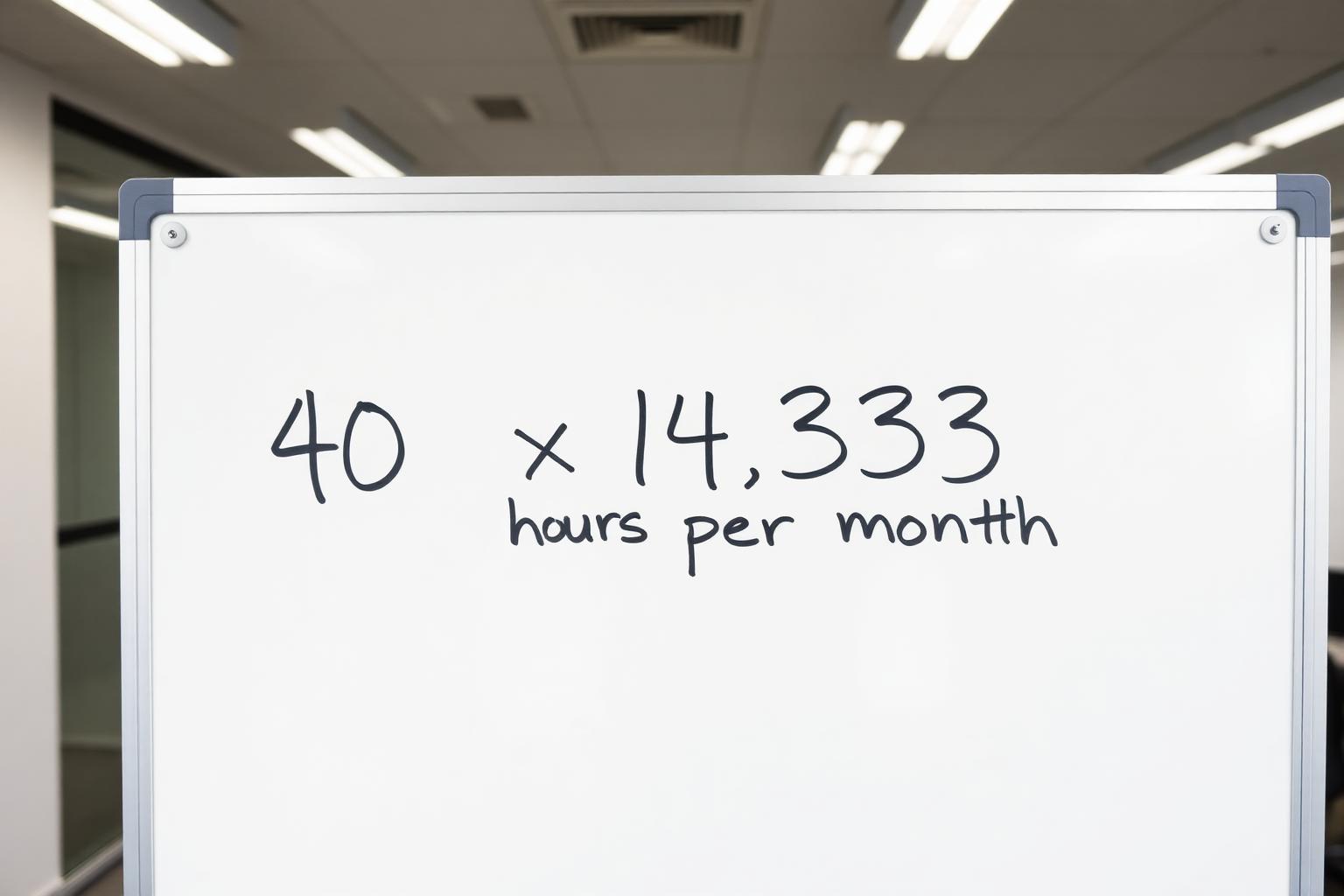
This is the one that confuses people. Some HR systems use 173.33 as the standard monthly work hours. Others use 160. Others use whatever the actual business days were that specific month.
The 160 version assumes 4 weeks per month. Which isn't quite right. There are 4.33 weeks per month on average. So 40 × 4.33 = 173.33.
Some industries use 2,080 as the annual work hours and divide by 12 for monthly. That gives the 173.33.
Others use 1,920 (which assumes 4 weeks of vacation). That gives 160.
Both are conventions. Neither is "correct" in a deeper sense. What matters is that everyone in the same payroll system is using the same one. Mismatched conventions are how you end up paying someone twice for one month and not at all for another.
What the online calculators are actually for
Most "hours in a month calculator" tools online do the trivial calendar math. Days in the month times 24. They're useful for the people who didn't want to look it up and didn't want to multiply.
The harder calculation, the work hours version, is usually built into payroll software rather than offered as a free tool. Because the work hour math depends on which convention you're using, plus your specific business days, plus holidays, plus PTO. That's not a calculator. That's a payroll system.
If you actually need work hours for a specific month, the easiest way is to count business days on a calendar and multiply by 8. For November in a typical year, that's about 21 business days, or 168 hours. For February, around 19 days and 152 hours. That number is more useful than the calendar hours total for almost everything except academic curiosity.
Quick reference

The numbers most people actually want:
Calendar hours per month: 672 (Feb), 696 (Feb leap), 720 (30-day months), 744 (31-day months).
Average calendar hours per month: 730 in a normal year, 732 in a leap year.
Standard salary work hours per month: 173.33, using the 40 hours × 4.33 weeks formula.
Average business-day work hours per month: 160 to 168, depending on holidays.
Work hours in a year: 2,080 standard, or 1,920 if you're netting out a four-week vacation.
That's most of what you'd ever need. The rest is just multiplication.